 Skip to content
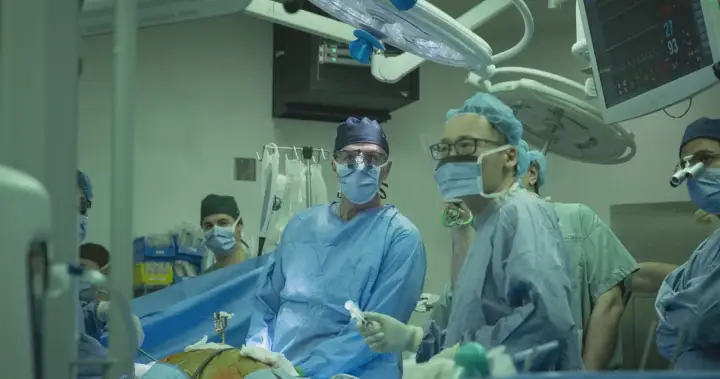
A new Canadian approach to treating a common heart rhythm condition could change the game for patients dealing with atrial fibrillation or AFib.
AFib is considered the most common arrhythmia and occurs in the upper chambers of the heart.
Affecting one to two percent of the general population, the irregular heartbeat can cause symptoms such as shortness of breath and fatigue, but can lead to serious consequences such as stroke or heart failure.
Fatigue made Edmonton’s Jon Davies suspect something was wrong.
“I used to go hiking and play a lot of squash and then that kind of went away quickly when I got into my early 50s,” he told Global News in an interview. “I just thought it was age and having a desk job and not enough exercise maybe.”
His wife, Nora, said he was often tired and would sleep a lot.
He was eventually diagnosed with atrial fibrillation, but when he talked about treatment options, he was left in shock.
“They told me my heart had enlarged so much that there was no point for them to treat it surgically, so that’s when they said you stay on blood thinners,” Davies said.

Get weekly health news
Get the latest medical news and health information delivered to you every Sunday.
Until this year, he said he had to accept the “status quo,” adding that he would get a second opinion with the same result.
People with AFib often receive treatment either through medication or with what is known as “catheter ablation.”
“Patients are usually sedated or put to sleep and we put little tubes in the groin and we put wires down into the heart, cross to the left side of the heart and what we try and do is kill the tissue around the pulmonary veins,” said Dr. Paul Angaran, cardiac arrhythmia director at St. Michael’s Hospital in Toronto.
The process involves creating small scars in an area of the heart, according to the Mayo Clinic. During AFib, faulty signals can tell the heart to beat irregularly. The scars prevent the false signals from reaching their target.
“Typically we burn, so we use energy sources that overheat the tissue and sometimes we can use energy sources that freeze the tissue,” said Dr. Gianluigi Bisleri, the director of minimally invasive and robotic cardiac surgery at St. “But either way, we create these scars that become permanent and stop the irregular heart rate.”
But Angaran said not everyone with AFib will find such treatment effective.
Angaran joined Bisleri to develop a new approach to help people with AFib.
The result is a two-part robotic technique that uses ablations from outside the heart and then goes inside with a catheter technique.
“It allows us not only to use the robotic technologies that give us more dexterity, more ability to reach and see the heart, but also to treat wider areas of the heart with ablation,” said Bisleri.
Using both minimally invasive robotic surgery and catheter technology is a Canadian first, Bisleri said.
Patients interested in the procedure must be referred to Bisleri and Angaran, but the former told Global News that while a referral is easy, there is not enough awareness of their approach.
Patients must wait several weeks or months between each procedure, with Angaran noting that doctors want the patients’ scars to have healed on the outside before proceeding with the internal procedure.
One of her first patients was Davies, who learned about the procedure by searching online.
Davies had the first part of the procedure, the robotic technique, in September and is expected to return to Toronto in the coming weeks for the catheter ablation.
“It’s nice to potentially, you know, take that diagnosis and direct it to a much more humane, in a way that is, you know, much more appreciative than the alternative,” he said.
Angaran told Global News that in patients with long-standing persistent atrial fibrillation, the long-term success rate through this approach could hit as high as 70 to 80 percent.
–with files from Katherine Ward of Global News
© 2026 Global News, a division of Corus Entertainment Inc.
