 Skip to content

Businesses and consumers expect inflation to remain elevated in the near term as the breakdown in Canada-US trade negotiations and the conflict in the Middle East continue to put pressure on prices and costs.
According to the Bank of Canada’s new quarterly Business Outlook Survey (BOS) published Monday, many business leaders expect Canada’s overall inflation rate to remain above three percent over the next two years.
About half of the companies surveyed said they planned to pass on some or all of their cost increases related to the Iran war and tariffs. Companies that have already passed some of the previous cost increases planned to pass on past increases to customers in the next 12 months.
Businesses also expected their non-labor production costs and sales prices to moderate but remain elevated over the next 12 months.
Canada’s headline inflation rate ticked higher to 3.1 percent year over year in September from three percent in August, largely due to higher energy prices caused by the Iran and Russia-Ukraine wars.
“These price plans reflect some improvements in demand as well as the desire of companies to recover margins compressed by previous cost increases. However, some companies, more than in the previous quarter, also reported that competitive pressures continue to limit their ability to raise prices,” reads the BOS.
However, central bank officials noted that many of the BOS responses were collected before trade talks with the United States on August 22. Many companies’ outlook has worsened and inflation expectations have increased since then, but they do not expect them to return to levels seen at the beginning of the trade conflict in March 2025 and the peak in global oil prices in April.
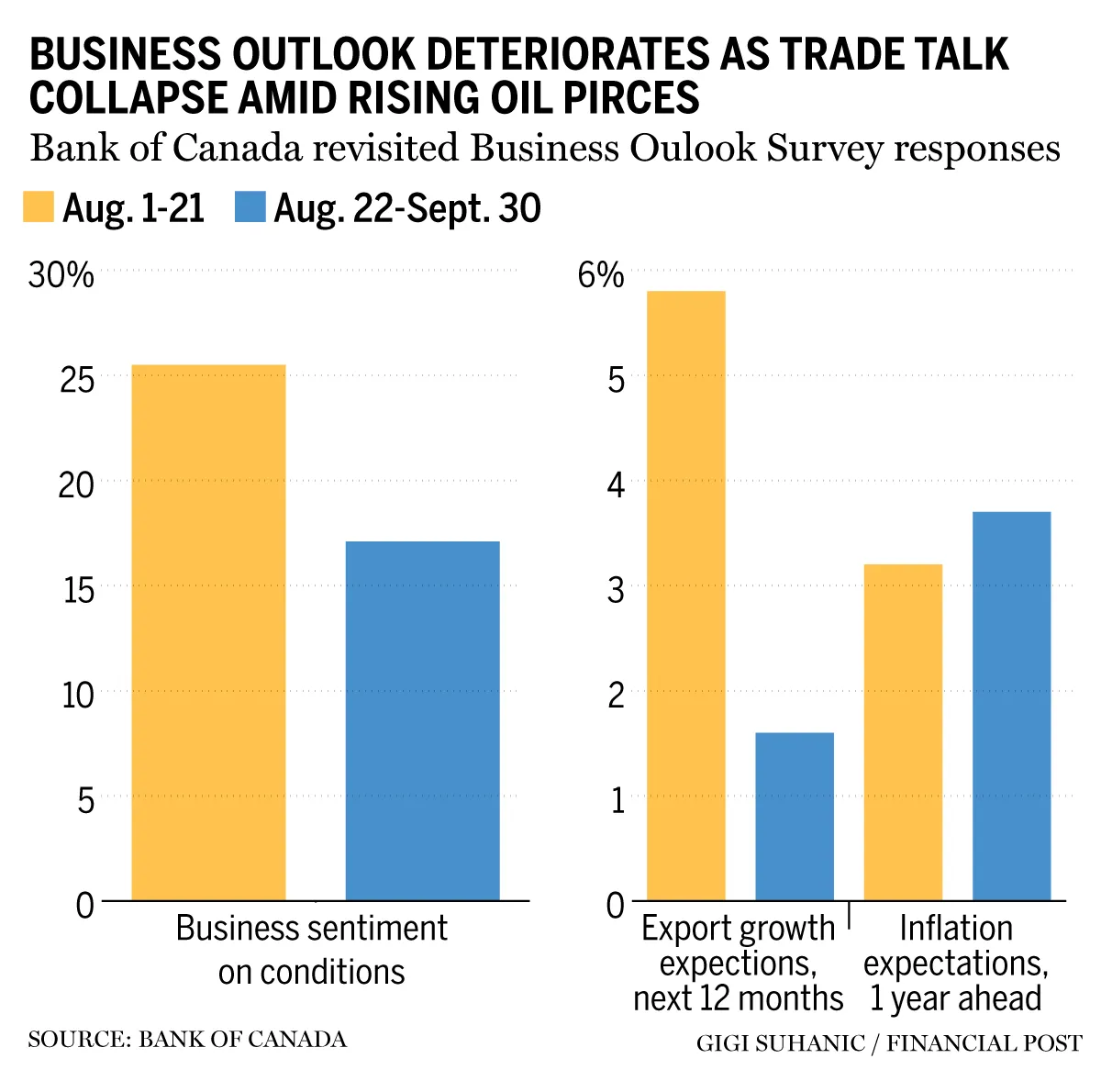
Still, the Bank of Canada said sentiment and expectations remain “significantly stronger” than at the height of trade tensions last year, suggesting a moderation rather than a fundamental shift in corporate outlooks.
Special consultations held in July and August also suggest that companies adapt to trade tensions by changing supply chains, increasing spending on technology such as artificial intelligence and automation, and looking for new opportunities by diversifying their export markets.
Many companies have also reported plans to invest in digital technologies – including artificial intelligence, machines and automation systems – to improve productivity and efficiency. However, uncertainty surrounding US trade policy continues to hold back companies’ capital spending plans, even as trade tensions weigh less on near-term sales, and employment intentions remain soft below their historical average.
“Most companies expect to keep staffing levels unchanged, often commenting that current levels are sufficient to meet expected demand… Some companies also expect automation and other efficiency improvements to increase productivity, allowing them to meet the increase in sales without adding workers,” said the BOS.
Meanwhile, higher fuel prices and tariffs are also putting upward pressure on spending for Canadian households.
According to the new quarterly Canadian Survey of Consumer Expectations (CSCE), which was also published on Monday, the median value says that many of those surveyed expect inflation to be up to 4.03 percent over the next year and 3.88 percent in the next two years.
Long-term expectations (3.91 percent) also moved higher this quarter and are now in line with the current perception of inflation (3.9 percent).
Respondents continued to cite tariffs and trade tensions as the top factor affecting inflation. Consumers who responded to the survey after the Canada-US talks broke down reported slightly higher inflation expectations on each horizon, and many respondents described how tariffs would increase the prices of everyday purchases in follow-up interviews.
Energy prices were also widely cited as a source of inflation, although the CSCE said that fewer respondents mentioned them in the third quarter of 2026 than the previous quarter. Most believe the Iran war will increase inflation over the next 12 months, and several respondents expressed concern about higher gasoline prices spilling over to other goods and services.
“Consumer spending intentions decreased in the third quarter of 2026 and remain below the average of the survey. High prices of goods and services remain the top barrier to consumer spending,” said the CSCE.
“Spending intentions continue to be weaker among households that expect the war in the Middle East to significantly increase inflation than among other households.”
Monday’s BOS and CSCE are two key reports that the Bank of Canada’s governing council will use as part of its deliberations on the key interest rate.
The central bank is scheduled to make an interest rate announcement on October 28, along with the publication of a new quarterly monetary policy report.
• Email: ptran@postmedia.com
