 Skip to content

The competitive gaming industry has grown rapidly over the past two decades, transforming from a niche subculture into a global phenomenon watched by millions of viewers worldwide.
More than 3 million fans attended the 2025 Esports World Cup in Saudi Arabia alone, according to organizers of the tournament, where professional players and teams will compete for over US$70 million (£53 million) in prize money.
As I found in my own research, eSports are no longer just competitions between players. They have become arenas of significant geopolitical competition in three main ways, as instruments of economic development, soft power and statecraft.
1. Pillar of economic diversification
Saudi Arabia has invested heavily in esports as part of its broader efforts to reduce its economic dependence on oil exports. Through its National Gaming and Esports Strategy, announced in 2022, the Saudi government aims to support 250 gaming companies and create 39,000 domestic jobs.
The Esports World Cup, launched in 2023 and financed by Saudi Arabia, as well as the 500,000 square meter gaming and esports hub in the planned Qiddiya City, are main parts of this strategy. The ambition is to bring gaming studios, tournament venues, technical expertise and tourism to the Saudi economy.
Supported by the Kingdom’s sovereign wealth fund, Saudi Arabia’s National Gaming and Esports Strategy aims to contribute 50 billion Saudi riyals (US$13.4 billion) to the national GDP by 2030.
Salman Al-Mazini / Wikimedia Commons, CC BY
As part of these efforts to become the world’s largest gaming hub, Saudi Arabia has also been looking to gain direct stakes in the businesses behind the global esports industry.
The Saudi state-owned Savvy Games Group announced in 2022 that it had acquired ESL Gaming and FACEIT, two of the largest esports tournament organizers, for a combined US$1.5 billion. It later completed the $4.9 billion acquisition of Scopely, one of the world’s largest video game developers.
2. Building soft power
Some states also use esports to generate soft power. China, for example, has creatively used mobile gaming to turn its traditional culture into something that young audiences around the world can experience and share.
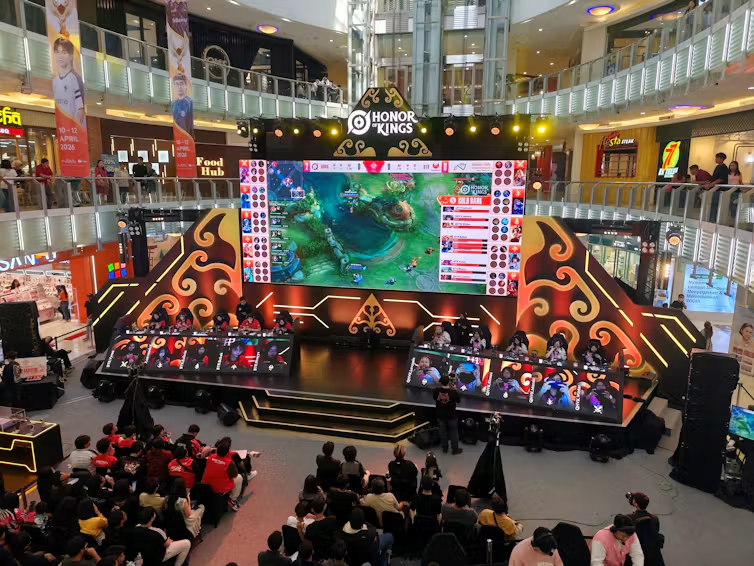
Honor of Kings, a video game played by over 100 million people every day with major international championships and professional regional leagues, provides a direct way to reach Chinese culture to people abroad.
Produced by the Chinese company Tencent, the game draws heavily on Chinese history and cultural heritage. In 2025, the game’s developers created a character costume in collaboration with Fu Xianghong, a prominent Suzhou embroidery artist.
Tencent is not only acting on instructions from Beijing. The company has strong commercial reasons to expand its audience abroad, as new markets bring significant income.
However, video games intended for release in China must be approved by the government’s National Press and Publication Administration, which reviews content under strict national regulations. This gives the state substantial influence on the Chinese gambling market.
Kesy Sasta/Shutterstock
This digital diplomacy does not always mean exporting Chinese culture abroad. Mobile Legends: Bang Bang, a game produced by the Shanghai-based company Moonton, shows a subtle track. The game features characters based on Lapu-Lapu, a Filipino historical figure, and Gatotkaca, a figure from Indonesian mythology.
At the opening ceremony for the 2026 Mobile Legends: Bang Bang World Championship, a professional tournament held in the Indonesian capital Jakarta, the actors portraying Gatotkaca appeared in performances. They also participated in city-wide tournament promotions.
Their inclusion is an example of a Chinese gaming company counting on local history in an attempt to connect with regional audiences and build goodwill abroad.
3. Sanctions and Disputes
Esports can seem borderless because matches are played in virtual spaces and hosted over online networks. But the power behind them is rooted in the real world. War and security conflicts can thus determine who competes, under what conditions and through what platform.
Following Russia’s full-scale invasion of Ukraine in 2022, ESL Gaming has restricted the participation of esports organizations with alleged links to the Russian government. Affected players are allowed to compete under neutral names, as has been the case in many other sports worldwide.
Then, after the start of the war in Iran, the 2026 Esports World Cup was moved from Riyadh to Paris. The inaugural Esports Nations Cup, which was also supposed to be held in Saudi Arabia, has also been postponed. It has been delayed until 2027, although this could be extended if Yemen’s Houthi rebels continue to escalate their military campaign against Saudi Arabia.

Teresa Suarez / EPA
Long-standing tensions between India and China have also had a disruptive effect on the competitive gaming industry. In September 2020, India blocked access to 118 China-related apps, calling them a threat to national sovereignty and security. This includes the games PUBG Mobile and PUBG Mobile Lite.
Before the ban, PUBG Mobile had around 30 million daily active users in India. Access disrupted a booming local esports ecosystem, halting tournaments and displacing professional players and streamers who had built careers around the game.
The global eSports industry has grown to the extent that it rivals many mainstream sports in scale, viewership and cultural reach. For the many countries now fighting over who can build, finance, host and govern the industry, this has not gone unnoticed.
