 Skip to content
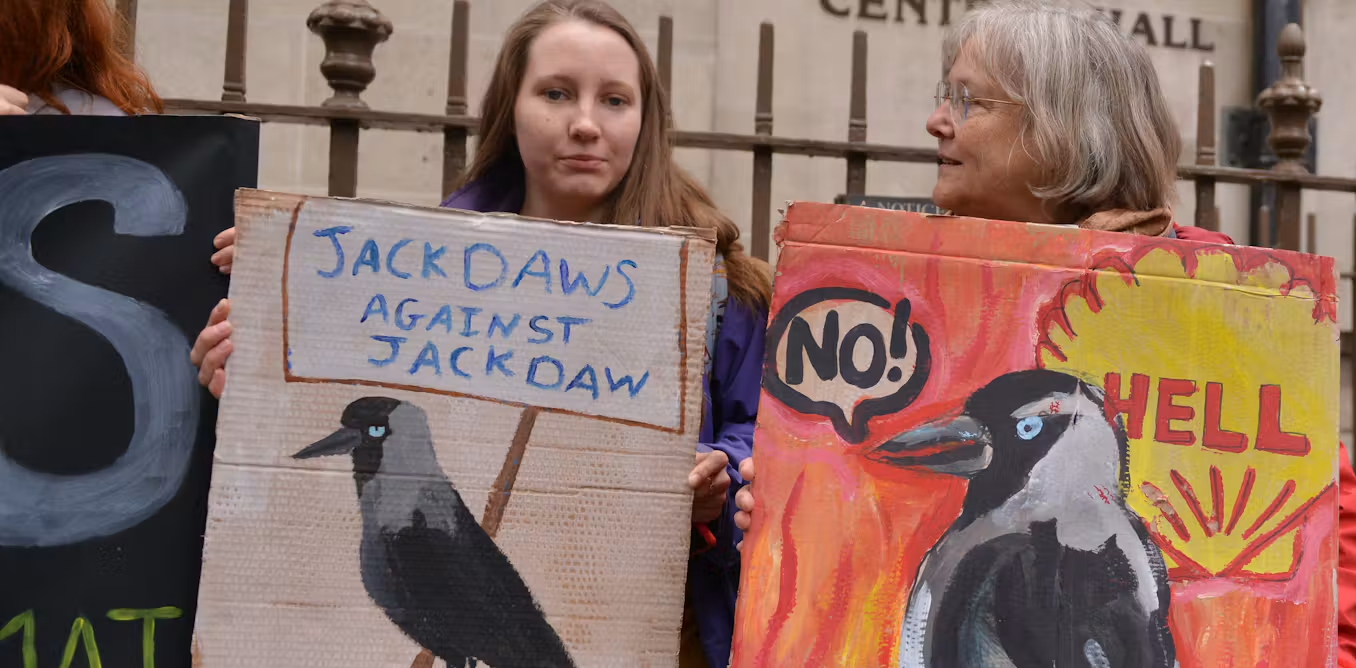
Although the announcement that the UK government is going ahead with the Jackdaw gas field in the North Sea was anticipated, it has generated a wave of criticism from around the world. This will have significant implications for the UK’s international standing on climate change.
Britain’s debate over new drilling has focused on job creation, energy security, emissions and the UK’s climate commitments, and the claim that the gas field has already been licensed by the previous government.
Researchers and advocacy groups have poured cold water on this reasoning, questioning the scale of the economic benefits of a project that will meet just 2% of UK gas demand for ten years – and that’s if none is exported.
The original consent for Jackdaw was scrapped in 2025 for failing to account for its total emissions footprint – including that generated when the gas is actually burned. The field is owned by Adura, a joint venture between Shell and Norwegian energy giant Equinor. The developers had to submit a new environmental assessment, and the government had to decide again whether to approve the project in light of the full emissions assessment. That is, it is not an inherited decision: the government must own it directly.
Move in the wrong direction
As more countries commit to phasing out fossil fuels and publish plans to do so, the UK government has moved in the opposite direction. By approving this project, the UK is showing that similar projects around the world are permissible, leaving its government no reason to object to fossil fuel projects elsewhere.
At the UN’s Cop30 climate summit in Brazil last year, then energy secretary Ed Miliband said he would “fight” for an outcome that included a roadmap to move away from fossil fuels. The UK has joined over 80 countries in calling for the roadmap, acting in solidarity with countries already suffering the effects of climate change. Now the government is giving new drilling. “That double standard,” said Mohamed Adow of thinktank Power Shift Africa in response to the Jackdaw news, “will not go unnoticed”.
Geopix / Alamy
This blow to Britain’s credibility on the climate was not inevitable. Despite the incredibly challenging backdrop of energy price shocks and supply costs, many governments are leaving fossil fuels in the ground. Our research shows that these policies range from bans and moratoria on specific types of extraction or in certain areas, to subsidies for fossil fuels and restrictions on export credit. Many governments have begun to work together on these policies as part of “climate clubs”, sharing best practice and pooling leverage.
Indeed, the UK has pioneered many of these initiatives. It played a leading role in establishing the Powering Past Coal Alliance and the Clean Energy Transition Partnership, which grew out of a UK policy. It was the first G7 nation to enshrine Net Zero in law and has made climate diplomacy a perennial feature of foreign policy across both Conservative and Labor governments.
What’s more, North Sea production is in long-term decline, with assets approaching retirement and employment declining for years. Meanwhile, renewable energy is increasingly driving growth. If Britain cannot hold the line on fossil fuel production and manage the phase-down of existing operations, what hope do less wealthy, less economically diversified countries have?
A global shift away from fossil fuels
A more appropriate question may be where true leadership comes from. In 2027, governments will gather for the second conference on Transitioning Away from Fossil Fuels – a process launched this year in Santa Marta, Colombia, and attended by countries representing a third of global fossil fuel consumption and a fifth of global production. Co-hosted by the governments of Ireland and Tuvalu, a low-lying island nation whose existence is threatened by climate change, the conference provides a forum to develop coordinated measures to reduce dependence on fossil fuels, beyond the constraints of the annual UN climate summits, where everyone has a veto. In a world where multilateral cooperation is increasingly difficult, these governments are actively building a new geopolitics.
They are also faced with the reality of falling global demand for fossil fuels, with high-cost projects in declining basins such as the North Sea most at risk if demand falls. The International Energy Agency expects to top fossil fuels within four years. As sales of solar panels and electric vehicles accelerate at a dizzying pace following another global energy crisis, peak demand may come sooner than expected.
The legal reason has also shifted. The International Court of Justice has produced an Advisory Opinion that clarifies that the destruction of the climate by the exploration and production of fossil fuels constitutes an internationally wrongful act. Although the UK government’s own decision document denies this, the Jackdaw decision is likely to trigger legal challenges.
The British government is now facing two challenges quickly. A decision on Rosebank, the UK’s largest untapped oil field, is still pending. And at the beginning of November, Andy Burnham and the British delegation will attend the next UN climate summit, Cop31 in Antalya, Turkey.
Rejecting Rosebank allows the government to draw a line under the new production and recover some leadership quality. But if Rosebank is approved, the UK will provide a blueprint that any fossil fuel producer – established or potential – can follow. Countries suffering from climate change today, and increasing momentum to phase out fossil fuels, will not let the UK forget it.
