 Skip to content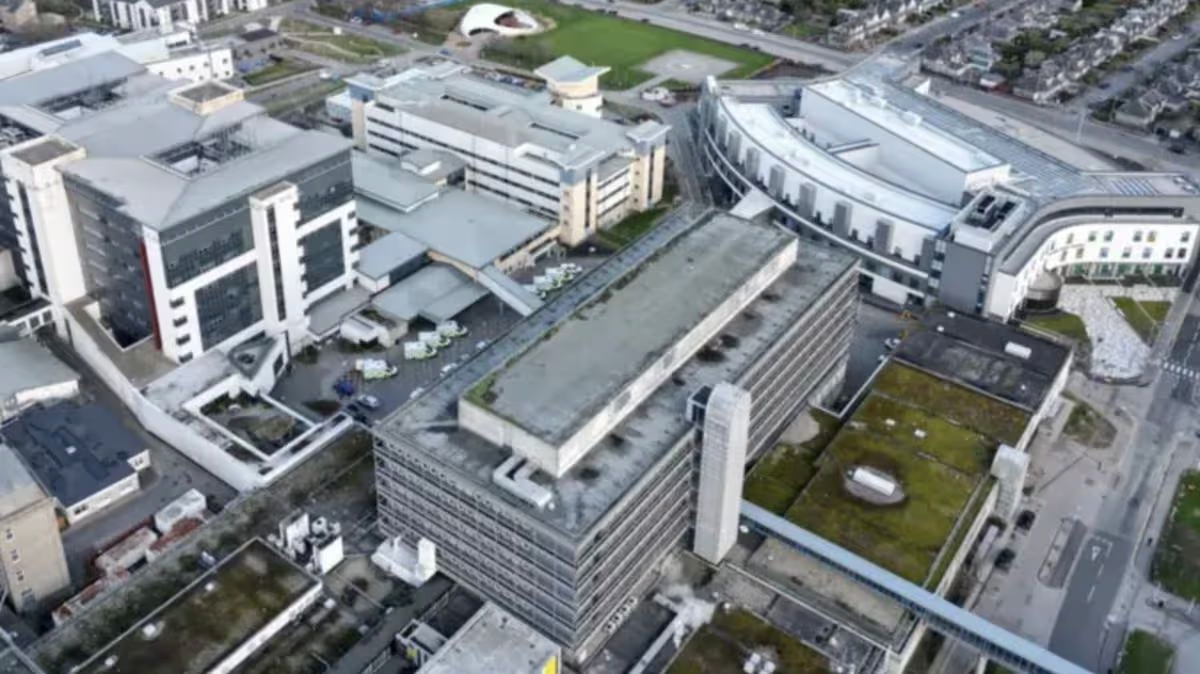
Tragically Michael Wilson died at the Royal Aberdeen Children’s Hospital aged just two months.
The family story of a baby who tragically died in an Aberdeen hospital should have “triggered alarm bells”, a fatal accident inquiry (FAI) has heard.
Little Michael Wilson was born at Aberdeen Maternity Hospital on August 11, 2021, but died at Royal Aberdeen Children’s Hospital two months later on October 15.
Michael’s older brother had a suspected inherited heart condition known as familial elastin atrophy (FEA) and died of complications following heart surgery in 2019.
The FAI was also told that in 2021, Michael would have to undergo urgent surgery for a hernia repair at the age of just two months old.
The Lord Advocate considered that the death of the baby occurred in circumstances “that give rise to serious public concern”, and the FAI was ordered to discover the circumstances of his death, with particular focus on the understanding and recognition of the risk and complexities of his condition, information sharing between the health board and with family members.
Dr Adele King, who is currently a pediatric anesthetist at the Royal Hospital for Children in Glasgow, was asked to look at Michael’s case after his death and give her opinion on how she should have managed his care.
Speaking to the FAI on Friday, she said Michael’s family history had given rise to a degree of uncertainty, which she believed warranted further investigation before he went in for hernia repair surgery.
Dr. King said the baby had an echocardiogram (echo) of his heart when he was just a few days old, and a second scan a few weeks later.
She said Michael “did not have a normal echo” result.
The inquest heard that his neonatologist advised an urgent cardiology appointment in light of his scans and family history, even though he had no symptoms.
Dr. King said: “I appreciate that we have to do (the operation) in a timely manner … but with the concerns that I’m seeing, I think it might be delayed for a day or two to investigate these things.
“If I was presented with a baby with abnormal echo changes and a family history that is unknown, I would still be concerned about it.
“It wouldn’t really sit right – even if the baby was fine, they would still refer to cardiology for the family history.”
The inquiry also heard from NHS Grampian consultant pediatric anesthetist Dr Alan Barnett, who reviewed patient records before Michael underwent the hernia operation.
He told the inquest that his patient records did not mention any family heart conditions.
However, he understood that the hereditary heart disease suspected to be Michael’s brother is a “very serious condition and generally results in death under anaesthetic”.
Dr Barnett said: “If it (FEA) had been mentioned at any time it would have set off alarm bells in my head.
“If anyone had even mentioned it in relation to Michael and his family, I would have been much more suspicious… It would have definitely changed my appreciation of the risk.
“The exchange of information between health boards and between clinicians should be improved, and may have helped me in this case.”
Dr Barnett said if the Glasgow clinicians had passed on information about the family’s hereditary condition to the Aberdeen clinic, or if the family themselves had told him they were aware of a genetic abnormality, his management “would have been different”.
“If that had been in place, things might have been different,” Dr Barnett said.
Dr Alistair Baxter, a consultant anesthetist and the clinical director of surgery, anaesthesia, and theaters at the Royal Hospital for Children and Young People in Edinburgh, said he could not fault Michael’s care team for making the decision they did based on the information they had at the time.
He told the inquest it was “very easy to see the writing that was on the wall” in retrospect.
He added: “At the time Dr Barnett and Dr Davies met this child I don’t think they were prepared for what was going to happen.”
Dr Baxter told the inquest that the nursing team in Aberdeen would almost certainly have suggested that the baby’s hernia operation should be carried out in Glasgow if they had known the family had a history of suspected FEA.
“I think it’s a tragic event that happened, but I don’t see – unless there was proper communication from either the Glasgow team or the parents or the GP, how Dr Davies and Dr Barnett were in any way able to know what was going to happen,” he said.
“If information about the severity or potential severity of this condition had been passed on to his parents, and if that had been in a letter signed by either the GP or the parents, then I am absolutely convinced that both Dr Davies and Dr Barnett would have stopped before they took this case and referred it to Glasgow,” said Dr Baxter.
He said that if Michael’s parents had been told in strong terms that the suspected hereditary condition carried a risk of death for any other siblings in the family, he is “absolutely convinced” they would have mentioned it to Michael’s anesthetist in 2021.
He said sharing information across borders and health boards is “very difficult”.
Dr Baxter added: “For this reason, the only way I can see this could have been prevented was a very significant letter sent to both the GP and the family to emphasize that any future siblings are at risk of death.”
Get more Daily Record exclusives by signing up for free on Google’s preferred sources. Click HERE.
