 Skip to content
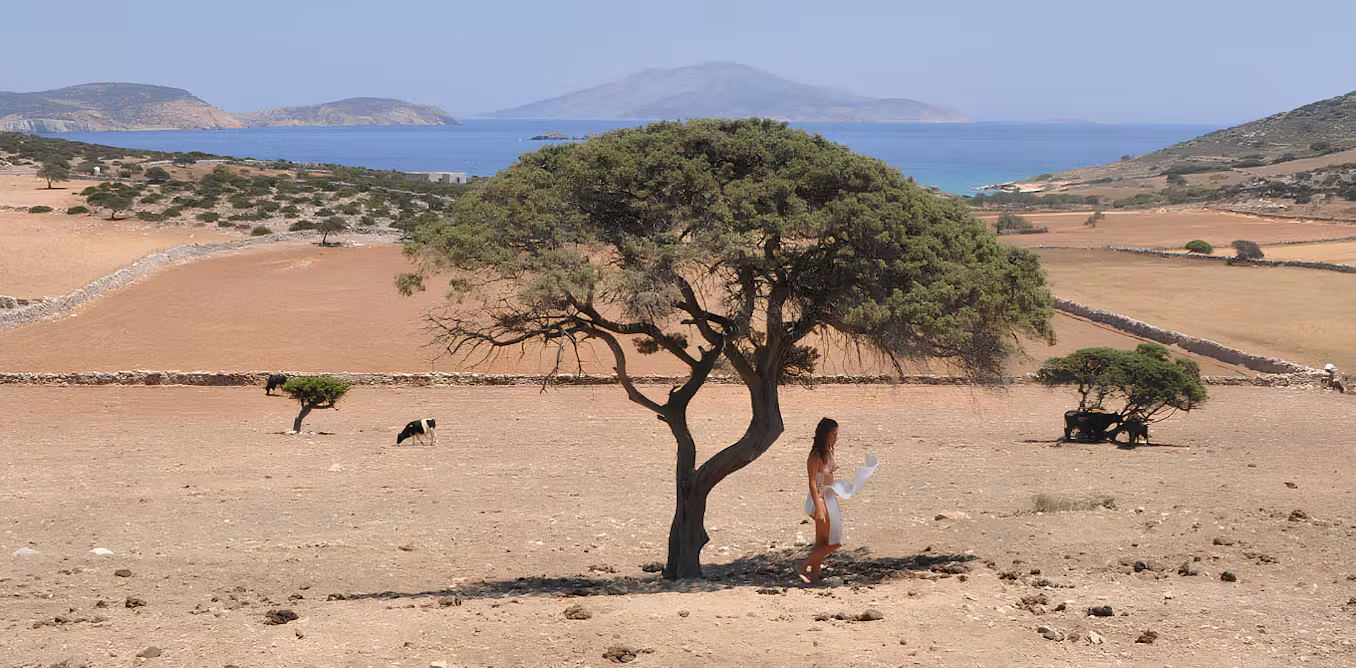
For decades, data has told the story of our ecological crisis. Scientists track carbon emissions, map deforestation and log biodiversity loss. But data alone cannot make humanity feel the reality of a changing planet. True impact depends on a language shift – a vocabulary that dissolves the boundary between humanity and the living world.
Phoebe Giannisi embodies this shift. Poet, classicist, performer, architect and environmentalist, Giannisi has produced one of the most radical bodies of eco-poetry in contemporary literature. Her work blends ancient Greek myth, site-specific performance, video poems and field recordings to provide a long-lasting lesson in what it means to co-exist on a vulnerable earth.
Giannisi’s environmental message is anchored in the Chimera. In classical mythology, the Chimera was a fiery monster, part lion, part goat, part snake. For Giannisi, this creature is not a monstrous abstraction but a biological and ethical reality.
Tassos Vrettos
In her collection Chimera (2024), Giannisi bridges ancient myth with modern genetics, drawing a line from Homer’s legendary goat chimera to the scientific phenomenon of microchimerism – as cells from one organism live permanently in another. Humans, her poetry suggests, are inherently collaborative creatures. As she writes in the poem Chimera II:
Call me Chimera.
A being consists of
other beings
A being with different genetic codes
incorporated.
Several genes linked
in a body.
Multiple bodies.
Giannisi’s poetry challenges the delusion that humans stand apart from nature, either as masters or saviors. Instead, she invites her readers to recognize that we are composite creatures, physically and ecologically entwined with the world around us. To harm the landscape is to tear apart our own multi-species body.
This philosophy comes to life through Giannisi’s use of multiple voices. Her poems, now collected in Goatsong (2025), abandon the solitary narrator to develop as living ecosystems where human and non-human voices hold equal weight. In her second poetry collection, Cicada (2022), the protagonist is the eponymous insect. Giannisi layers ancient texts by Plato, Archilochus and the Japanese poet Bashō, alongside observations of the insect’s life cycle and its dreamy mating calls. His song becomes environmental testimony – a non-human language that demands the reader’s attention.
Giannisi’s focus deepened in Chimera, her third collection. In it, she follows the ancient traditions of the Vlach herding communities in northern Greece, who move their animals seasonally between mountain and valley pastures.
Rather than romanticizing pastoral life, Giannisi constructs an archive of shared survival, rebuilding state archives, regional oral histories and her own field recordings. In her live performances, Giannisi blends the cries of shepherds alongside the roar of the hearth, the roar of a passing motorcycle and the grinding crunch of a cement mixer.
This acoustic space forces the listener to inhabit the modern industrial world and the ancient animal landscape at the same time. It is an ecology of sound that captures both the beauty of shared life and the vulnerability of an environment under threat.
Language as a material way
Trained as an architect, Giannisi perceives language as a physical way to walk, taste and feel. When I hosted Giannisi at the Center of Hellenic Studies, Harvard in October 2023, I saw this spatial approach to poetry taking shape in space. There is an intimate, architectural precision to how she moves language off the page and into a shared physical space.
Beowulf Sheehan / Onassis Antigone Festival New York
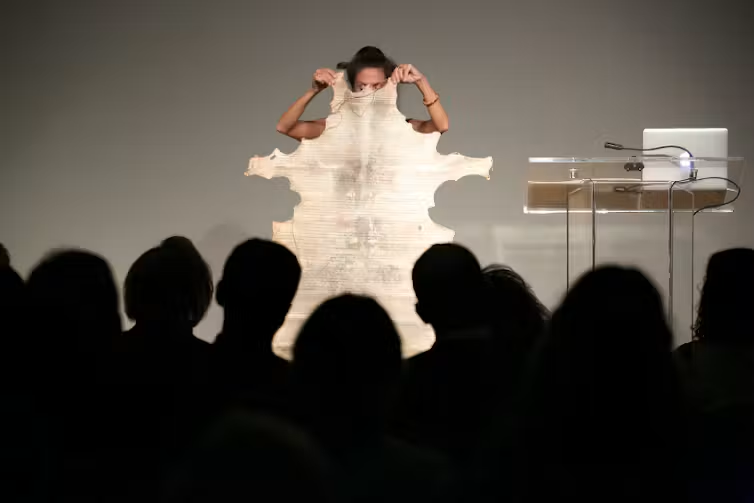
For her 2017 installation Aigis II at the Panourgias Museum in Amfissa, Greece, Giannisi inscribed her poetry on semitransparent goatskin parchment. On the one hand she followed traditional migration routes and on the other hand she wrote verses. As I observed the spectators handling the parchment, the written word and the geography of the earth hide themselves through the animal.
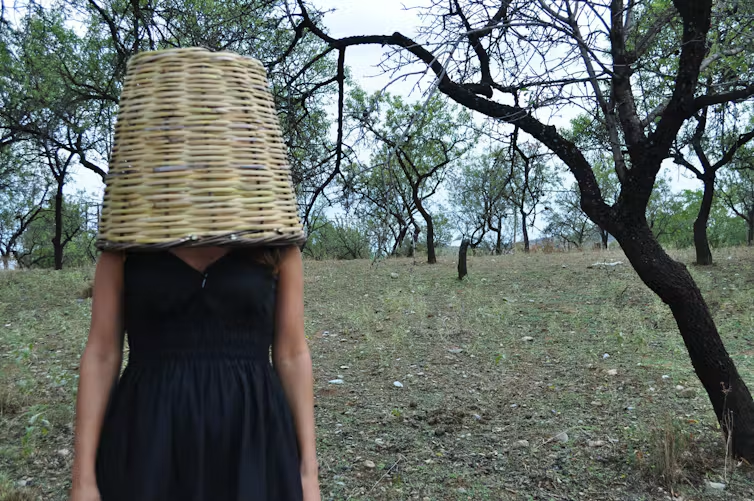
In this method of composition, the human body becomes the primary medium for environmental memory. In her performances, Giannisi routinely blocks her own view with a cloth or basket, deliberately decentering her own human gaze to open up a vulnerable, sensory relationship with her environment. Her poems are filled with the taste of an earth cicada, the sting of sea salt and the sharp smell of animal droppings.
This late fall, the physical performance of environmental memory is coming to the University of Bristol. I will join Giannisi and her poet-translator, Brian Sneeden, to see how these ancient textures resonate in a new architectural space, letting our contemporary landscape and classical myth collide once again.
Grounding her poetry in these realities allows Giannisi to create a space where human and environmental forces interplay. This strategy has a subtle political edge, positioning her work as a defense of the “commons”, the common resources currently being mined for economic gain. Their collaborative projects, including acoustic explorations of marine soundscapes, bear witness to the devastating loss of biodiversity driven by climate change and industrial expansion.
Yorgos Rimenidis
In the boundary-crossing tradition of poet and translator Barbara Köhler and 2026 Nobel Prize winner Anne Carson, Giannisi dissolves the divisions between myth, scholarship, and creativity, turning them into vital tools for navigating our difficult era.
Surviving the ecological crisis requires a whole new framework of imagination. We are called to see our world not as resources to be exploited, but as a vast, interconnected web where the song of each creature breathes life into the whole.
