 Skip to content
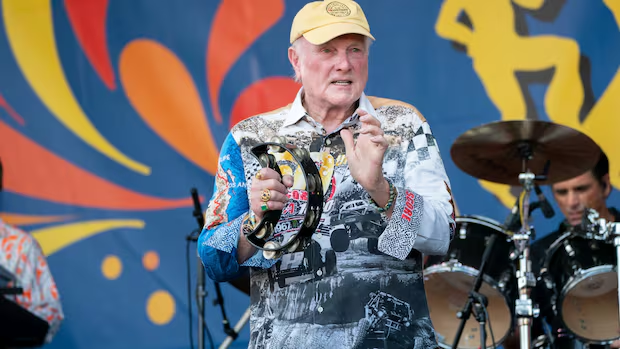
Mike Love, the charismatic, sometimes cantankerous frontman of the Beach Boys, who sang some of their biggest hits and was a constant in the group’s touring lineup for more than six decades, has died. He was 85.
“It is with great respect that I share that Mike Love passed away this evening, surrounded by family,” his spokeswoman, Katie Altman, confirmed to Variety and other media on Saturday. The cause and place of death have not been released.
Love was forced to cancel several shows this year and fans were alarmed when he returned in October for two shows in which he appeared weak while sitting on stage. His longtime Beach Boys bandmate Al Jardine, who performs with a separate group, said he was “shocked” and “really depressed” after seeing footage of Love struggling.
Love, cousins Brian, Dennis and Carl Wilson, and friend Jardine founded the iconic group in Southern California in mid-1961. The group’s harmonized songs of teenage love and youthful pursuits on beaches and in cars resonated with teenage boomer audiences around the world, crystallizing for fans an image of California just as that state became the largest in the United States.
“They made me love America so much more because they existed,” said Briton Elton John when he inducted the Beach Boys into the Rock & Roll Hall of Fame in 1986.
Mike Love and John Stamos attend the world premiere of the documentary ‘The Beach Boys’ at the TCL Chinese Theater in Los Angeles, California, US on May 21, 2024.(Mario Anzuoni/AFP)
Love’s nasally twang featured prominently on chart-toppers I come around, Good vibes in the Kokomoas well as many top 20 hits such as Surf ‘USA, Fun, fun, fun in the California girls. He also had a hand in writing lyrics on dozens of songs while working with the group’s acknowledged production whiz, Brian Wilson.
“I’ll be the first to admit that ‘excitement’ isn’t really a word, but it rhymed,” Love said, referring to the chorus of the song that lent its title to his 2016 autobiography, Good Vibrations: My Life as a Beach Boy.
The Beach Boys were inducted into the Rock & Roll Hall of Fame’s second ever induction class, but Love’s 1987 acceptance speech lived in infamy. He challenged big names like Paul McCartney, who skipped the event, and other musicians.
“I’d like to see Mick Jagger come out on this stage and do it I come around vs Jumpin’ Jack Flashany day now,” he told a bemused audience.
Behind the clean image of the band was a history of internal strife and tumult. Murry Wilson, father of three of the band members, promoted and helped produce the band early on, but was a dominating presence and eventually fired from the band.
Brian Wilson retired, first from the tour and then later from the studio, beset by drug addiction and mental health issues. Dennis Wilson introduced Charles Manson and his followers by accident – the band even recorded a song by Manson, an aspiring musician, just over a year before the cult’s 1969 murderous rampage.
In the 1970s, Dennis and Carl Wilson struggled with their own drug use problems. Dennis Wilson would drown while intoxicated swimming in 1983, and not long after Carl Wilson’s death from lung cancer in 1998, Love received permission through the band’s internal organization to keep leading musicians on tour under the Beach Boys name.
“My cousin Brian loves the studio, but I love performing,” Love told Rolling Stone in 2016. “I think I probably sang Fun, fun, fun live close to 6,000 times.”
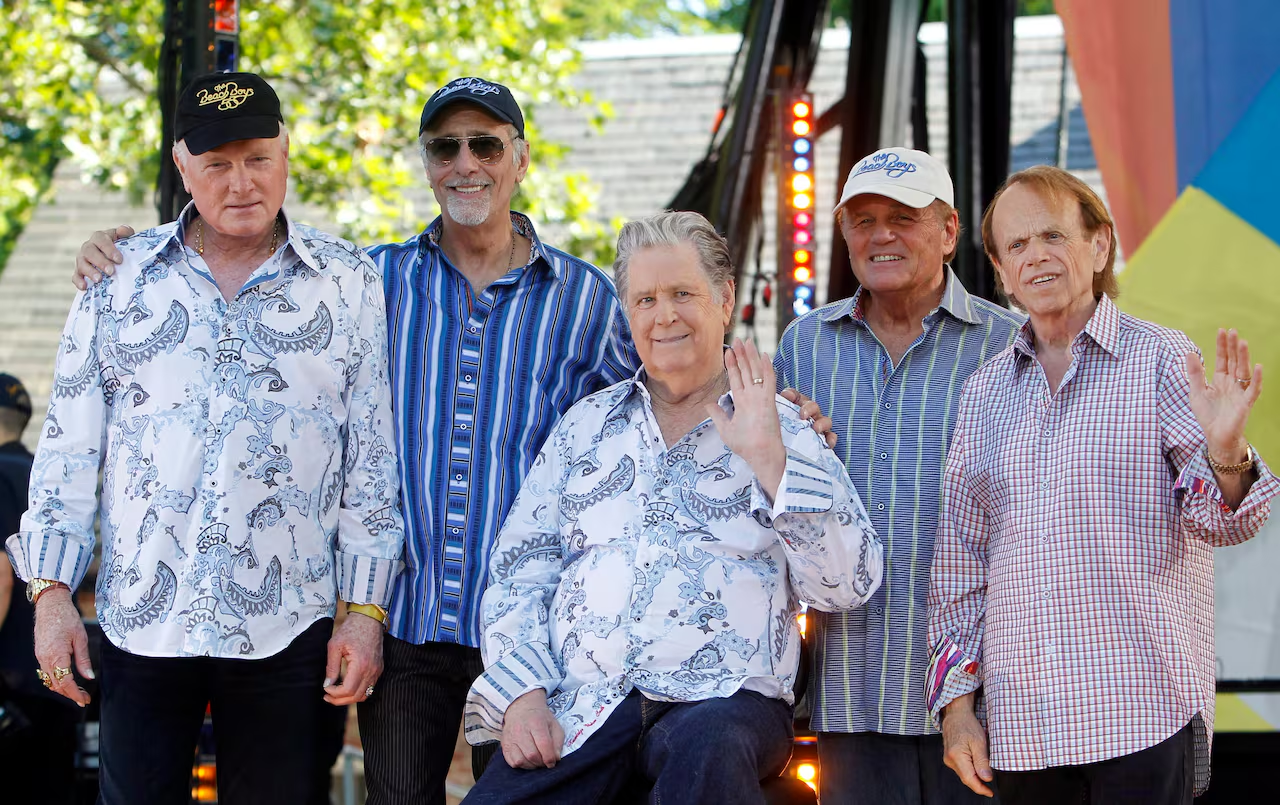
Original members of The Beach Boys, from left, Mike Love, David Marks, Brian Wilson, Bruce Johnston and Al Jardine appear on stage during ABC’s “Good Morning America” summer concert series, Friday, June 15, 2012, in New York.(Jason DeCrow/Associated Press)
No gig was under Love, who enjoyed performing in small towns before the usual touring circuit, at county fairs, minor league baseball stadiums or corporate gigs, into his 80s. The cute striped shirts of the 1960s and the gold lamé vests he favored in the 1970s eventually gave way to a love of reliably wearing a baseball cap and a Hawaiian or paisley shirt.
Love successfully sued Brian Wilson in the early 1990s for millions owed, as well as songwriting credits, in connection with a series of bad deals signed years earlier by his cousin and uncle. But Love appeared more churlish in 2001 when he sued his other bandmate for touring as “Al Jardine of the Beach Boys,” a case that lasted seven years before a settlement was reached.
Love, Wilson and Jardine overcame differences for a well-received 50th anniversary tour in 2012, alongside Bruce Johnson and David Marks, two other notable Beach Boys members over the years. But the tour ended in confusion and recriminations – including open letters to the Los Angeles Times from Love and Wilson.
Love got tired of being the most criticized member of the group.
“To those who believe that Brian walks on water, I will always be the Antichrist,” he said in his memoir.
Early start
Love was born on March 15, 1941, the eldest of six children. The Wilson-Love clan was musically inclined, with Christmas and other extended family gatherings often turning into singalongs.
Love was a 20-year-old college dropout who was working as a gas station attendant at his father’s sheet metal company when the group was formed. Influenced by the rhythms of Chuck Berry and the vocal harmonies of doo-wop vocal groups, Dennis Wilson – the only member who could ride a wave – encouraged them to tap into the growing surf subculture for material.
The band’s chosen name for their first recorded songs, The Pendletones, after a clothing brand favored in the surfing community, was changed to the Beach Boys by a local record distributor, a stroke of lasting good fortune.
They signed with major label Capitol Records in 1962, and released their debut album, Surf Safarilater that year. By the time the group reached their first No. 1 with I come around in 1964, Love was a father of two in the process of divorcing the first of his six wives.
Love was said to have cried as some songs grew more conceptual and surreal, with Brian Wilson pushing the band into increasingly sophisticated soundscapes, inspired by the productions of Phil Spector and the Beatles.
Wilson created what was seen as the band’s masterpiece in 1966 – Animal soundsto participate God only knows in the Wouldn’t it be nice – but the later collection of songs, known as the Smile LP, overwhelmed him and he began his descent.
By the late 1960s, the band struggled to fill concert halls in the United States, seen in some quarters as a relic as mainstream music grew louder and more psychedelic.
The group was dropped by their label, but became more fully collaborative in the absence of Brian Wilson after he joined Warner Records. However, the hits – among them Darlin’, Rock and roll music, Good Timin’ in the Gotta back – became more sporadic.
Brian Wilson returned to the fold periodically, especially for the 1976s 15 largethe band’s biggest selling album in a decade. But, Love said, “Brian was in no shape to take responsibility, his once flawless tracks marred by idiosyncratic arrangements or strange musical textures that others had to fix.”
Brian Wilson, after touring later in life than during the band’s prime, died in 2025.
In a group of free spirits, Love was a teetotaller who passionately pursued transcendental meditation as a lifestyle not long after attending the same 1968 spiritual retreat in India as the Beatles and Mia Farrow.
A father of eight children, Love would finally see stability in his personal life in the late 1980s, meeting Jacquelyne Piesen and marrying her in 1994.
Despite occasional bad blood between their parents, Love’s son, Christian, and daughter, Ambha, Jardine’s sons and daughters joined the three Wilson brothers for a tribute group, California Saga, for the Beach Boys ’50. anniversary to form.
In the end, love fostered the legacy of the family, as expressed in his memoir.
“Despite the obvious dysfunctionality of the Beach Boys as a group of people, to be able to take this music – all these hardships and trials and tribulations, all the unhappiness and self-destruction, the self-absorbed behavior – but if you take the music, that’s the story of it, right? The value of the music, and what it means.
