 Skip to content
A hidden threat is making it harder for bees, butterflies and other pollinators to do their jobs: Air pollution is destroying the flower canopy they use to find flowers.
Colleagues and I have just published research showing that ground-level ozone and nitrogen oxides (two pollutants strongly associated with fossil fuel use) affect the ability of pollinators to locate and feed on flowers.
The good news? The global shift away from fossil fuels, including the rise of electric vehicles, could eventually ease this pressure. But the timing is important. Things may get worse before they get better.
Flowers release complex cocktails of volatile organic compounds, essentially their perfume, to attract pollinators. These scents act like a GPS for bees and other insects.
But when ozone and nitrogen oxides (NOx) react with these compounds, they disrupt the chemical signals. The result is that pollinators struggle to find the flowers they need.
This is not just a problem for wild plants. Almonds, apples, canola, strawberries and many other important crops depend on insect pollination. If pollinators cannot forage efficiently, yields and quality can suffer.
What the evidence shows
We analyzed 22 experimental studies, mostly from Europe, that tested how increasing levels of ozone and NOx affect the ability of pollinators to find and feed on flowers, as well as their overall abundance.
On average across the studies, elevated ozone reduced pollinator performance by 42%, while NOx reduced it by 46%. When the two pollutants occurred together (as they do in the real world), the average reduction was 68%.
However, only a small number of studies have tested pollutants both separately and in combination. In those comparisons, the additional impact of the combination of the two pollutants was relatively modest.
Pollinators’ search efficiency – the ability to locate flowers – was hit the hardest, dropping by an average of 67%. Feeding efficiency and overall abundance were less affected.
This suggests that the main problem with pollution is that it interferes with the ability of pollinators to find flowers, rather than being directly toxic to the insects themselves.
The coming ozone peak – and why it’s happening
There is a complication, however. NOx and ground-level ozone are chemically related, so NOx emissions do not necessarily directly reduce ozone. In fact, under a middle-of-the-road emissions scenario, global low-level ozone levels are projected to continue to rise until around 2050, even as NOx emissions begin to fall.
This is partly because ozone and NOx interact in the atmosphere. NOx can react with and destroy ozone. When NOx levels are high, as they often are near roads or in cities, this “quenching” effect helps keep ozone concentrations down.
So, as we reduce NOx emissions from diesel vehicles and other sources, this exclusion effect weakens. With less NOx around to break it down, ozone concentrations can actually rise. Other ozone-forming pollutants, such as methane, also persist longer in this scenario.
Only after this mid-century peak will sustained reductions in NOx and other precursors drive ozone levels down again. Under this middle-of-the-road scenario, ozone is projected to fall back below present levels by 2050. Faster decarbonization would speed this recovery.
Why diesel emissions matter
Diesel vehicles, especially heavy trucks and agricultural machinery, are among the biggest sources of NOx emissions.
In many regions, heavy diesel vehicles alone account for more than 70% of NOx on the road. These emissions do not only directly harm pollinators. Through their effects on ozone, they also change the chemical environment around the flowers.
Ivan Rwatchev / Alamy
Electric vehicles produce zero tailpipe NOx. Replacing diesel vehicles with electric alternatives, especially in freight, construction and agriculture, would cut a major source of NOx and, over time, help reduce the ozone pollution that disrupts the blue sky. The benefits would be even greater, as the electricity production becomes cleaner.
Our analysis shows that the rate of pollinator recovery depends heavily on how quickly we reduce these emissions. Delaying the phase-out of diesel vehicles would prolong the mid-century ozone peak and delay the ecological recovery we all need.
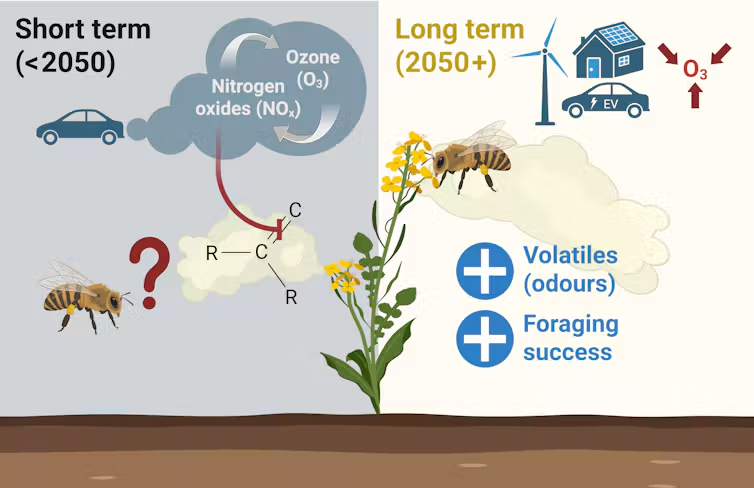
Created in BioRender. Ryalls, J. (2026) EVs for bees, CC BY
What must happen now
The protection of pollinators should be considered a co-benefit of clean air and climate policy. Accelerating the transition from diesel to zero-emission vehicles, especially in heavy and agricultural sectors where diesel remains important, would reduce a major source of NOx.
We also need better monitoring and research. Our evidence comes mostly from European studies on bees and some other pollinator groups. We urgently need more research in highly polluted, biodiversity-rich regions, and on a wider range of pollinators including moths, flies and beetles.
The timing and location of pollution reductions could also be important. Measures that reduce exposure during peak bloom, for example, could help limit disruption to pollinators before longer-term reductions in ozone set in.
The fossil fuel transition is not just about carbon and climate. It is also about restoring the chemical cues that pollinators depend on as they search for flowers.
If we move fast enough, we can shorten the difficult mid-century period and give bees, butterflies and the crops they support a real chance to recover.
The science is clear: cleaner air means healthier pollinators and more resilient food systems. Electric vehicles are one powerful tool in that toolkit. The sooner we deploy them at scale, the better the outlook for the insects that help feed us all.
