 Skip to content
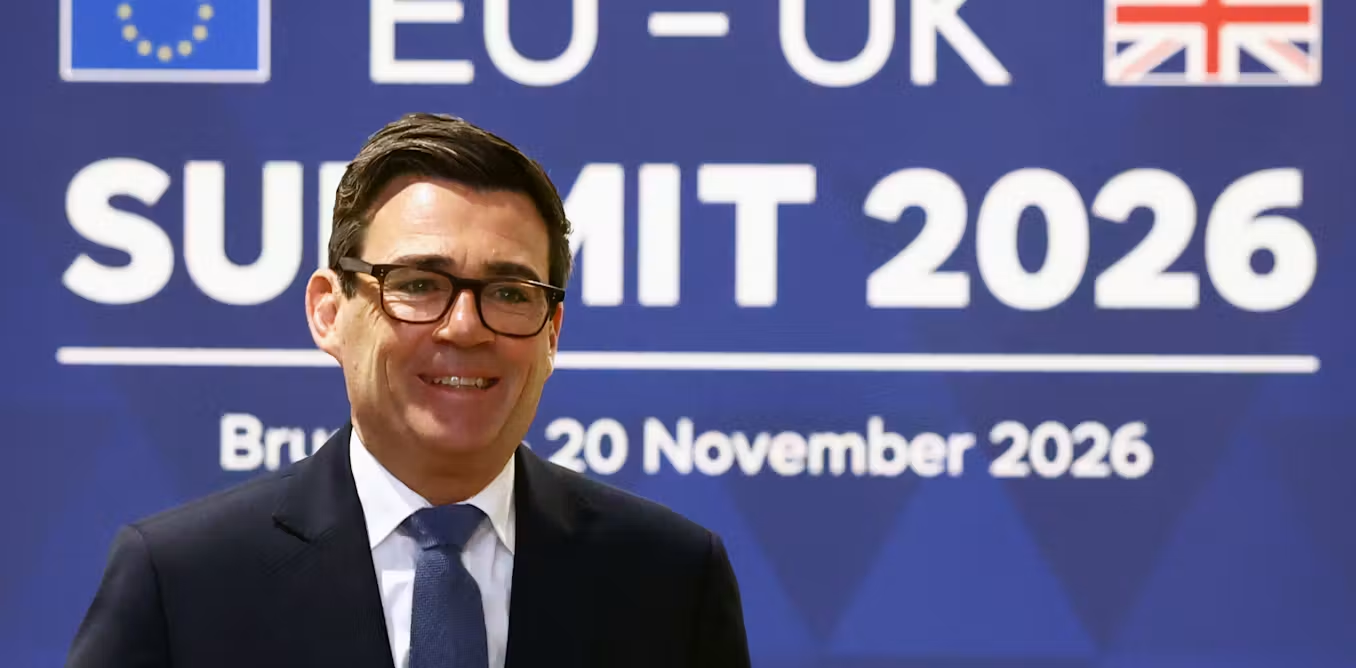
Andy Burnham attended his first EU-UK summit in Brussels with major agreements on youth mobility, food exports and carbon emissions. The Prime Minister will eventually understand that this was just the beginning of new political negotiations. Back home in Britain, he started a “national conversation” about the future of UK-EU relations, which quickly gained momentum.
Burnham had talks with European Council President Antonio Costa and European Commission President Ursula von der Leyen. Both Burnham and Costa come from sister social democratic parties and both are former mayors – Burnham of Greater Manchester and Costa of Lisbon. This could make for smoother meetings in the future than in the months and years after the 2016 Brexit referendum.
In the run-up to the talks, the Prime Minister repeatedly claimed that the Conservatives did not get a good deal from the EU. As part of former prime minister Keir Starmer’s “reset” of relations with Europe, the then business secretary, Peter Kyle, and European Commission vice-president Teresa Ribera signed a deal committing the UK and the EU to closer co-operation on trade.
Like Costa and Burnham, Ribera is also from a European social democratic party (the Spanish Socialist Workers’ Party, or PSOE). Senior figures in Labor have long admired the electoral success of the Social Democrats in Spain and Portugal.
When it comes to claims that the UK got a bad deal, there is an explanation that is under-discussed. It has its roots in the internal party politics of the center-right in Europe. Before the 2009 European Parliament elections, the then Conservative leader David Cameron decided to leave the European People’s Party (a bloc of centre-right pro-European parties).
Cameron went on to form a new right-of-centre Eurosceptic faction with parties from Poland and the Czech Republic. But he underestimated how hurt highly influential EU figures such as German Chancellor Angela Merkel were by the move. So when it came to negotiating a better deal with the EU before the 2016 referendum, Merkel and other figures had not forgotten Cameron’s betrayal. As such, they didn’t feel like meeting him halfway.
Burnham walks a fine line
Youth mobility, migration, food exports and emissions are all important issues. But the wider discussion is increasingly about the politics surrounding Brexit rather than the rights and wrongs of Brexit itself.
The UK will not rejoin the EU in the near future. Burnham even said when he stood in the Makerfield re-election that he wanted to sort out the consequences of Brexit, rather than necessarily the result.
Now Burnham increasingly focuses on the claim that Brexit did not work for British voters – without saying that it was completely wrong. He may understand that aiming to reverse Brexit in a binary way could simply open up new problems. It might even finish his premiership in the same way it finished the tenures of many prime ministers before him.
In contrast, however, Burnham understands that he has the political capital to discuss the downsides of Brexit. For now, at least, he can do so in a way that is unlikely to cause his government great political damage. Although it is not entirely without risk, he calculated that the benefits of discussing Brexit outweigh the costs.
EPA/ADAM VAUGHAN
These costs could include the fragile “red wall” of jobs in the North of England and the Midlands. The party knows all too well that this will shift to Reform UK the next time the country goes to the polls.
But those voters who have already moved to reform are a bit of a cost for Labour. For now, it seems that Burnham sees more advantages in drawing voters away from the Liberal Democrats and the Greens than he sees disadvantages in alienating supporters of reform. Conservative leader Kemi Badenoch appears to be sensitive to the fact that many people disagree with how the Tories have handled Brexit – regardless of whether they voted Remain or Leave.
At the height of the Brexit chaos, however, Burnham was mayor of Greater Manchester and can therefore examine the issue in a fresh way, unscathed by the Westministerial turbulence of the time.
His predecessor Starmer was often seen as paralyzed by caution. Burnham seems to know how to talk about difficult issues easily and fluently – his own parliamentary seat overwhelmingly voted Leave in 2016.
He may or may not really want to see the UK rejoin the EU at some point – he has sometimes sent mixed signals on the issue. But he certainly has the firm goal of removing the toxicity from the issue and having a “national conversation”. To do this, the Prime Minister must consider how Westminster relates to Brussels as well as how it relates to constituencies like his own in Makerfield.
