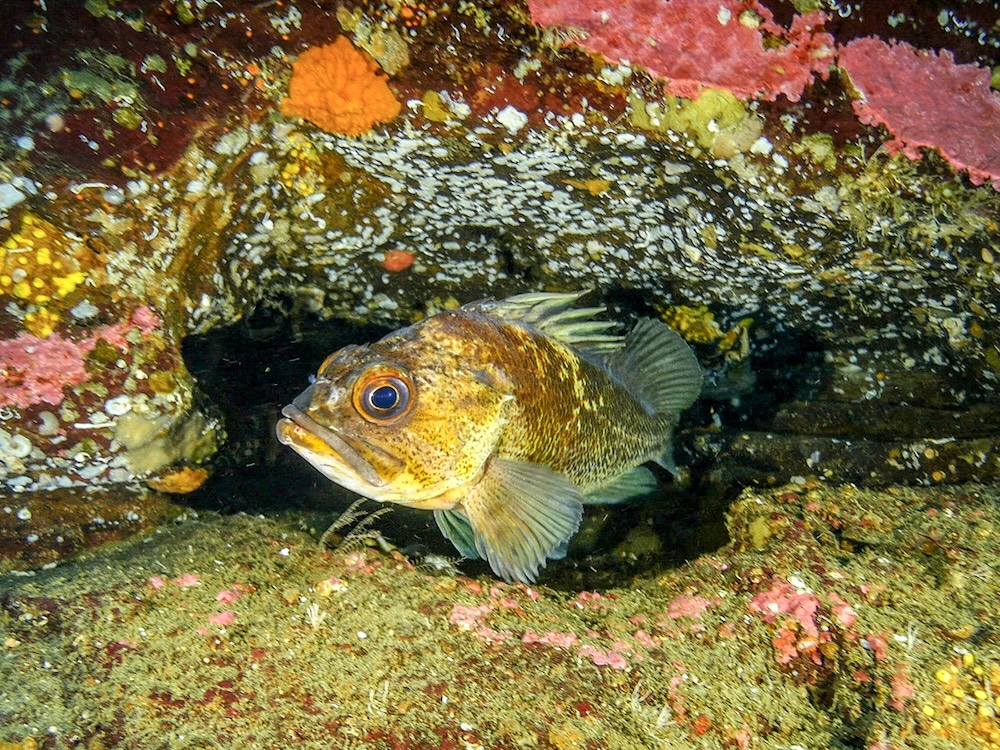
The first coast-wide study on rockfish conservation areas found that exclusion zones provide massive assistance to local fish populations.
Rockfish conservation areas prohibit many types of commercial and recreational fishing such as trawling, hook and line, spearfishing, angling, jigging and mooching.
Protecting rockfish by banning these types of fishing has a huge spillover effect. The benefits of rockfish conservation areas can be measured up to 100 miles away, according to the study, published Monday in the journal Ecology Letters.
Starting 160 kilometers away and moving toward the Rockfish Conservation Area, the average body size of rockfish increased by just over one percent every five kilometers, and average abundance of rockfish increased by 11 percent every five kilometers, the study found.
That’s a big deal because the size of a female rockfish is closely related to how many offspring she can produce, said Alejandro Frid, an independent ecologist and adjunct professor at the University of Victoria and Simon Fraser University, and co-author of the study.
The bigger the fish, the more eggs it can produce, and if a fish is big enough, even a small increase in body size can create a “disproportionately large increase in fecundity,” Frid said.
There are at least 35 species of fish in BC’s waters that fall under the genus Rockfish, so named because they like to make their homes in and around rocky reefs.
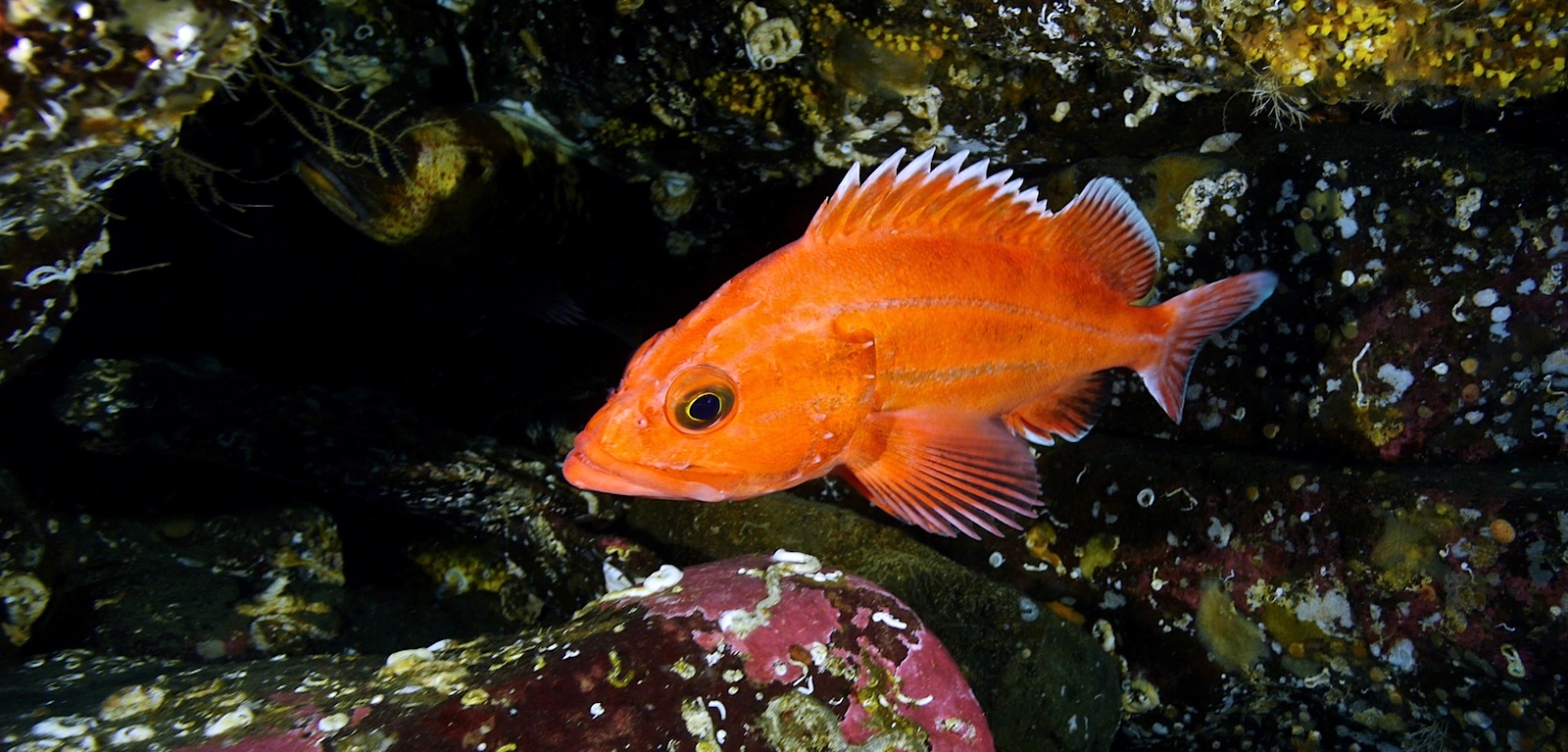
A Yelloweye Rockfish, observed during a dive survey on the Central Coast.
Photo by Tristan Blaine.
The smallest is the Puget Sound rockfish, which grows to about 18 to 20 centimeters, likely reaches sexual maturity after two to three years and can live up to two decades, Frid said. In contrast, he added, the yelloweye rockfish can grow to just under a meter long, reaches sexual maturity in its mid-to-late teens and can live up to 118 years. The Rougheye/Blackspotted Rockfish can live up to 150 to 200 years, and the Shortraker Rockfish can grow to be over a meter long.
Native peoples have been eating rockfish and managing local populations for at least 9,000 years, Frid said.
In the 1980s and 1990s, rockfish populations in BC plummeted due to overexploitation by commercial and recreational fisheries, the study says. The federal government changed how the fish can be harvested and established 162 rockfish conservation areas from 2004 to 2007 to stop the collapse of local populations. These areas limit fishing in about 20 percent of good rockfish habitat in the province.
The challenge of measuring success
Measuring the success of these areas is complex because there are so many different types of rockfish with different diets, habits and life cycles, and when the conservation policy was written, there were no clearly stated goals for researchers to measure, Kyle Wilson, the lead author of the study and assistant professor in integrated fish ecology at Simon Fraser University, told The Tyee.
To begin with, when evaluating a conservation area, you need to ask if the policy is working, for whom it is working (for example, are there healthier fish, more alive fish, are there enough fish for an indigenous food, social and ceremonial fishing, or is the goal to have a sustainable commercial fishery?), in which specific area it is working and how long it took to work, he said.
It’s a “much harder question to really wrap your head around when you start looking at what it means,” he said.
In the ocean, it’s also extremely challenging to isolate the potential benefits of a single policy, Wilson said.
For example, he said, take a square mile of ocean near the mouth of the Fraser River and consider the southern resident killer whale. That area would have developed overlapping regulations and conservation policies to protect whales: there are policies for ships, boats, ship strikes, fisheries and the Species at Risk Act. Zoom out, there is politics about pollution and climate change, and every single politician wants to know if their policy is working to protect the election.
“It’s a terribly experimental approach,” he said with a laugh. Scientists like petri dishes, controlled environments in laboratories and measuring the difference between a control group and an experimental group — none of which are available in the ocean, he said.
Indigenous led research
In the end, it was indigenous research that laid the foundation for the study.
Over the past two and a half decades, coastal First Nations have worked to develop the Great Bear Sea (Northern Shelf Bioregion) Marine Protected Area Network, which encompasses 102,000 square kilometers of marine area from the northern tip of Vancouver Island to the Alaskan border.
This came in early 2023, when 17 First Nations, and the provincial and federal governments, announced they would govern the area together.
First Nations have been doing their own research for decades leading up to that date, so Indigenous data and knowledge can be used to design the Great Bear Sea and at the same time be used to advocate for Fisheries and Oceans Canada to improve conservation, said Frid.
In 2023, four First Nations working together under the Central Coast Indigenous Resource Alliance completed a research project that collected 13 years of independent rockfish surveys over an 18-year period.
Data were collected from the ‘Wuìk̓inux̌v, Nuxalk, Kitasoo Xai’xais and Haíłzaqv (Heiltsuk) First Nations. The study analyzed that data on behalf of the Central Coast Indigenous Resource Alliance, Frid said, adding that he and Wilson worked for the alliance at the time.
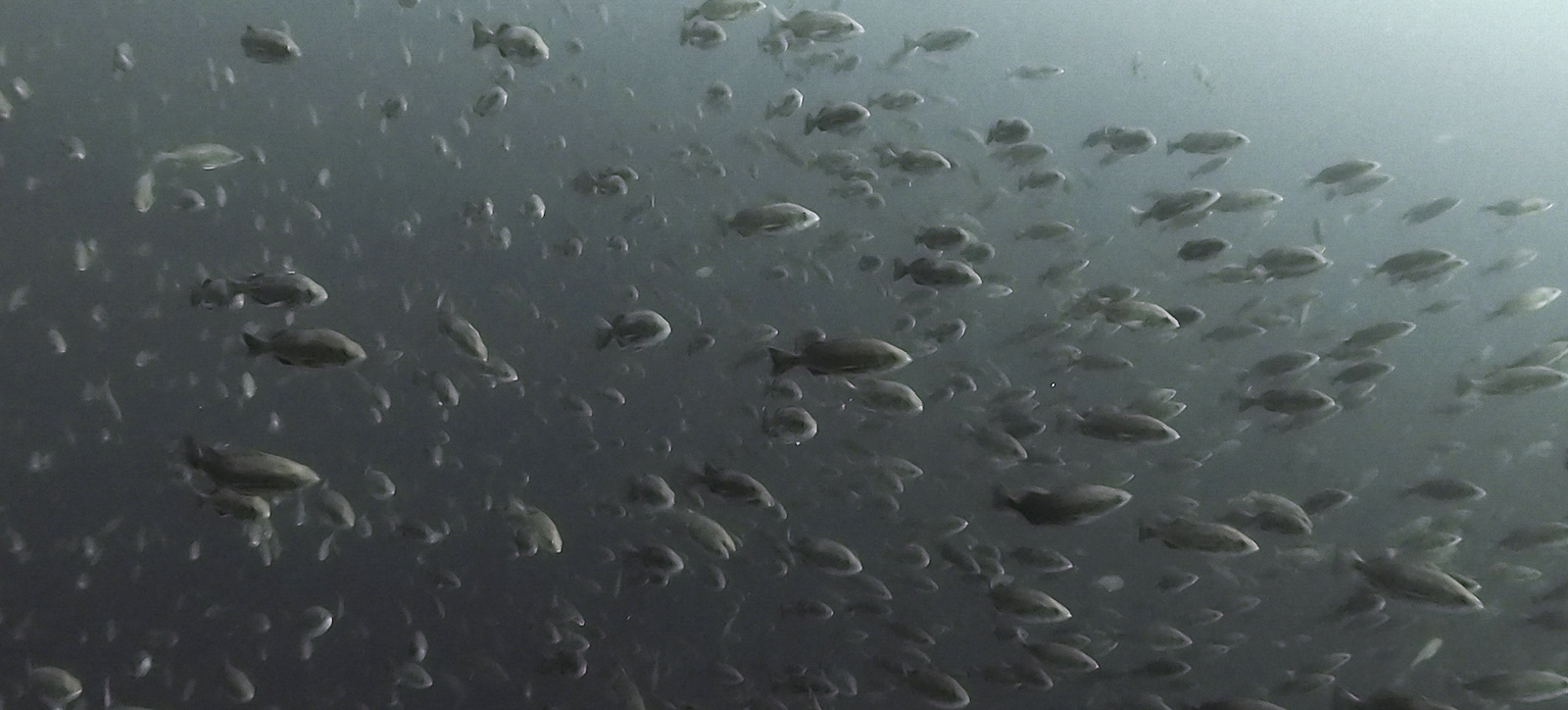
A school of subadult widow rockfish.
Photo by Tristan Blaine.
The surveys collected data on 26 rockfish species and fish in the same family, such as shortspine thornyhead and ling cod, which hang out in the same rocky reefs as rockfish and therefore benefit from rockfish conservation areas.
The researchers ran 4,307 transects within rockfish conservation areas and surrounding unprotected areas, with about three-fifths of these finding one or more species of groundfish. They collected this data by diving, collecting video footage from mid- and deep-water areas, and hook-and-line sampling, identifying close to 140,000 groundfish.
On a calm winter day, the water can be so clear that diving feels like skydiving, Frid said.
To conduct a dive transect survey, two divers descend 30 meters and swim over the most complex part of a reef. One diver counts and estimates the body size of fish, while the other records habitat-specific data, such as how complex the reef is. After 12 minutes they rise to about 15 meters, swim back over the reef, do the same and then make a third pass-over at five meters.
“You get to see incredible things,” Frid said. He swam by large schools of black, yellowtail and deacon rockfish and spotted yelloweye, tiger and quillback rockfish peering out from the rocky reef covered in brightly colored sponges and coral.
Video transects can drop a camera on a line between 15 and 500 meters and drag it behind a boat over a reef while watching the real-time feed to identify the fish.
Data was collected by divers such as Frid, Tristan Blaine, Sandie Hankewich and the late Ernie Mason, who worked for the Kitasoo Xai’xais, Indigenous food fishermen and Coastal Guardian watchmen, who did much of the video work and hook-and-line sampling, he added.
Central Coast Indigenous Resource Alliance member nations have rights to their territories where the data was collected, the study notes that the researchers have the permission of the rights to conduct this research and were exempted from other permit requirements.
This large data set was used to statistically quantify the relative abundance of typical rockfish, which improves within the conservation areas and that closer to the boundary line leads to population buildup and larger fish, Wilson said.
The study evaluated hundreds of kilometers and is the first study done in BC on this scale, both in terms of time and number of kilometers covered, he added.
It’s vital to conduct research like this to inform evidence-based policy, Wilson said, “especially in this era of skepticism toward science.” At the same time, policymakers must recognize that in field ecology it is not always possible to generate unequivocal statistical evidence for a single policy, he said.
“Instead of asking ‘Did our policy work?’ It’s better to ask, “How big is the effect, in what direction and how confident are we?” Wilson said. It is also important for policymakers to take a cautious approach and consider other ways to test to see if the policy is working, he added.
They also need to recognize that it could take a decade or more before the benefits of a conservation policy start to show in long-lived species like rockfish, he said. It may be difficult for politicians to think in four-year cycles, but “long-lived creatures do not benefit from short-term thinking.”
The older a rockfish conservation area is, the stronger its benefits, which would have been difficult to notice in a study shorter than 18 years, he added.
Wilson said this study will first be presented to marine stewardship and fisheries technical staff at the Central Coast Indigenous Resource Alliance and the stewardship departments of the Central Coast First Nations.
Their findings will help inform the ongoing Rockfish Conservation Area monitoring plan, which is a joint effort between Fisheries and Oceans Canada and First Nations, and will be used as evidence to support spatial protection through ongoing marine protected area development, Wilson said.
Ultimately, they want to make sure they “get the word out that there is evidence that these spatial protections in marine conservation can and do work, especially for these types of species,” he added. 