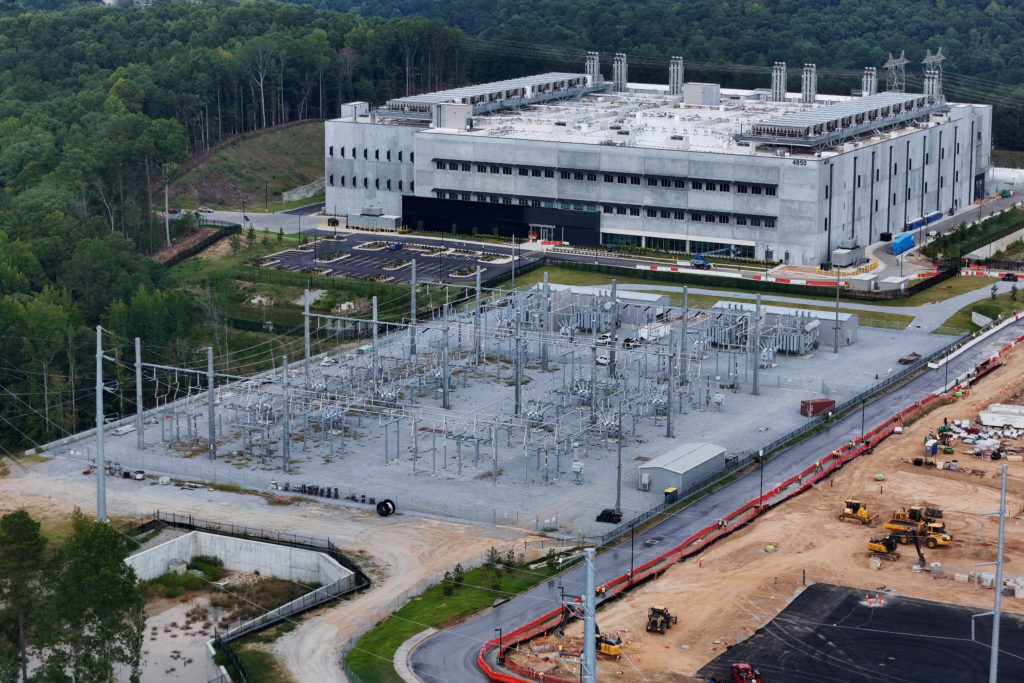
On his way home from a recent trip, Elitch Tapia drove past a sea of dark industrial buildings – data centers – that line the already congested roads of Northern Virginia.
“It was interesting to see how much the numbers would go up,” said Tapia, 30, a Republican from Arlington, Virginia, who works in higher education advocacy and policy. He said data centers provide valuable computing power that helps the United States remain competitive with other countries, but he is also concerned about the amount of electricity they use.
read more: The data center controversy transformed the midterm elections. Various groups stand here
Like Tapia, Americans have grown increasingly concerned about the impact of artificial intelligence on the environment in the past year, according to a new poll from The Associated Press-NORC Center for Public Affairs Research and the University of Chicago Energy Policy Institute.
Survey data shows that nearly half of Americans, 53%, are “very” or “extremely” concerned about the environmental impact of artificial intelligence. This is up from 41% last year. While much of the growing environmental concern is being led by Democrats, the poll also revealed broader concerns about the local impact of data centers, the powerhouses of AI and cloud computing.
read more: President Trump continues to embrace data centers, an unpopular theme in midterm elections
“We’re doing a large-scale experiment in real time, and I don’t think we’re ever going to put the milk back in the bottle. Change is scary, and I think some of that is reflected here,” said Michael Greenstone, director of the Institute at the University of Chicago, which collaborated on the study.
Concerns grow among Democrats about AI’s environmental impact
There are thousands of data centers in the United States, and more are planned. These include small, traditional centers that have existed for decades, as well as large hyperscale centers that are being built to serve the additional processing needs of artificial intelligence. Virginia and Texas currently have the most active facilities, with other potential candidates including California, Ohio, and New York.
According to a Pew Research Center analysis earlier this year, 87% of existing data centers are in urban areas, but most new data centers are planned for rural areas.
“I think the decisions are being made for the benefit of the companies, not the communities that the companies are embedded in,” said Nancy Antunez, a 60-year-old former Democratic congresswoman from Waltham, Massachusetts.
A recent United Nations University report found that the environmental footprint of data centers is already comparable to that of some of the world’s largest countries, and is predicted to increase rapidly as AI adoption increases.
Democrats are increasingly concerned about the impact of AI on the environment. The poll found that nearly two-thirds of Democrats say they are “very” or “extremely” concerned about the impact of AI on the environment, up from about half in 2025. By contrast, about half of independents and about 4 in 10 Republicans are very concerned about the impact of AI on the environment.
Overall, Americans are more concerned about the environmental impact of AI than other industries with higher environmental impacts. Only about 3 in 10 U.S. adults are highly concerned about the impact of meat production and air travel.
Most Americans support new data center limits
Concerns about the environmental impact are growing among Democrats, but alarm over the rapid data center boom is widespread.
About 6 in 10 Americans, including most Democrats and Republicans, support limiting the number of new data centers that can be built.
“AI data centers use so much water that it takes away from other things like agriculture and farmers and other places and people that really need water,” said Gedeon Kebede, a 21-year-old Democrat and computer science student from Cincinnati, Ohio.
A majority of Americans are “very” or “extremely” concerned about the impact data centers will have on electricity and water supplies in the areas where they are built.
Data center water use to cool AI chips and computers is “modest nationally but potentially decisive regionally,” Fengqi You, an energy systems engineer at Cornell University, said in an email. While data centers aren’t the biggest water guzzlers in the country, it’s still possible for a single large campus to overwhelm a small city.
The center is also powered by vast amounts of electricity, especially large-scale electricity, raising concerns about where that energy is coming from. Data centers could account for 11.8% of U.S. electricity consumption by 2030, according to a report from Lawrence Berkeley National Laboratory.
“We’re looking at building power infrastructure on a city-wide, even state-wide scale, just to serve one data center,” said Eric Nordman, director of Michigan State University’s Public Works Research Institute.
Roughly two-thirds of U.S. adults support requiring data centers to use clean energy sources, such as wind and solar, to supply their electricity needs. Roughly 8 in 10 Democrats support it, as do 56% of Republicans.
Still, some Americans say data center concerns feel far away. Mary Fisher, 68, hasn’t seen anything coming up in her Jacksonville, Fla., neighborhood.
“You know, I don’t think it’s something to be concerned about,” said Fisher, who is retired and identifies as a Republican.
Republicans think data centers are more profitable than Democrats
About a quarter of U.S. adults say data centers are “very” or “very” beneficial when it comes to technological advancement, and about two in 10 say the same when it comes to job creation. A majority of U.S. adults say they are either “somewhat” or not sure that data centers are beneficial to technological advances, while about a quarter say they are “not very” or “not at all” beneficial to technological advances, and about a third say they see no benefit in job creation.
“We’re seeing a significant increase in the number of temporary construction workers coming to the region, which is critical to the U.S. economy,” said Tapia, of the higher education advocacy group.
Republicans are more likely than Democrats to see the benefits of data centers. But about 3 in 10 Republicans still think the center will be “not very” or “not at all” beneficial for infrastructure and job creation.
Kebede, a computer science student, said she feels pressured to use artificial intelligence. Despite his concerns about technology, he wants to be competitive in applying for future jobs.
“I think a lot of people feel like this is really a bubble,” he says. “Ultimately, whether you bought into the AI hype or not, when it emerges it will be very detrimental to everyone.”
The AP-NORC poll of 3,424 adults was conducted from July 6 to 24, 2026, using a combined sample of interviews from NORC’s probability-based AmeriSpeak panel and an opt-in online panel designed to be representative of the U.S. population. The margin of sampling error for all respondents is plus or minus 2.2 percentage points. AmeriSpeak’s panel was randomly recruited using an address-based sampling method, and respondents were subsequently interviewed online or by phone. To incorporate the nonprobability sample, NORC used TrueNorth calibration. This is an innovative hybrid calibration approach developed at NORC to explicitly account for potential biases associated with non-probability samples.