 Skip to content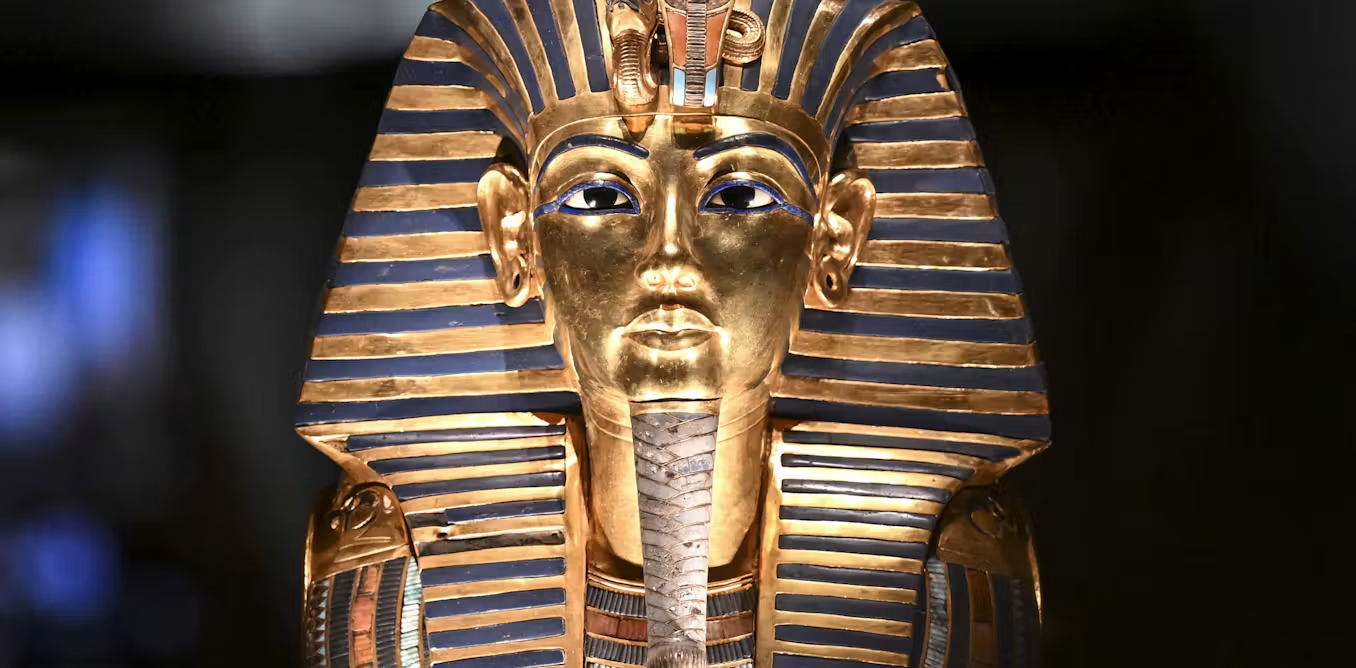
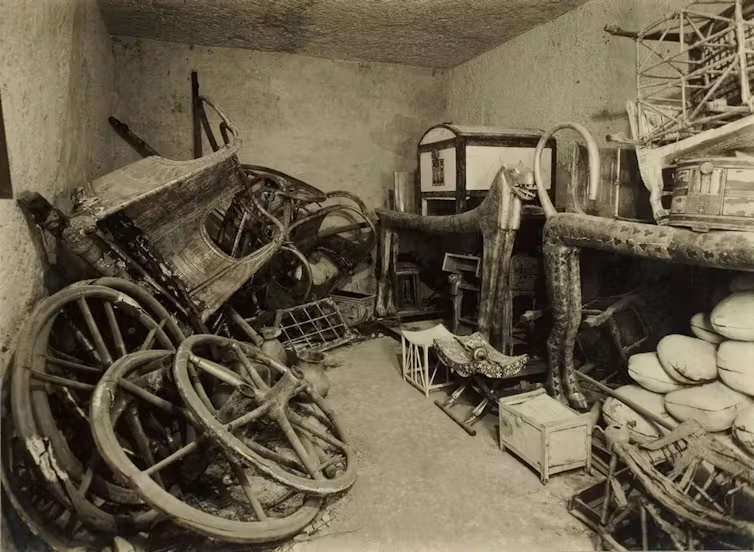
A growing body of research is generating renewed interest in potentially hidden spaces beyond the ornate walls of Tutankhamun’s tomb in Egypt.
Some researchers have raised the possibility that these hidden chambers – if they exist – contain the burial place of Nefertiti, Tutankhamun’s stepmother and mother-in-law. Nefertiti was made famous by a remarkable painted bust of her head found in Tell-el Amarna, Egypt, in 1912.
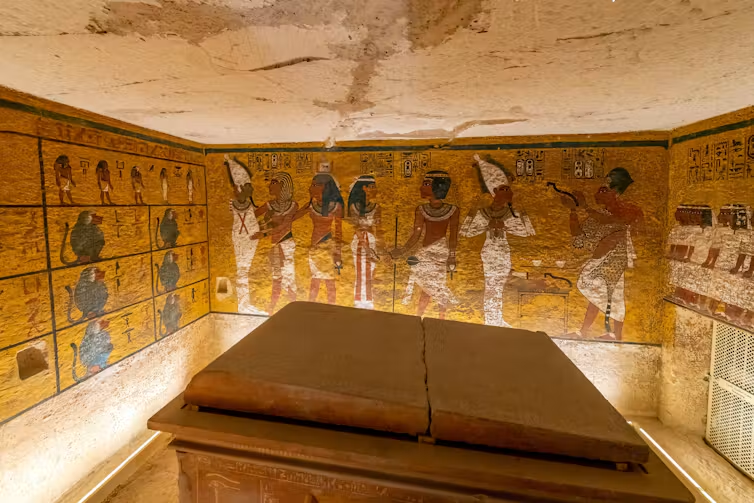
The hidden spaces hypothesis was first proposed more than a decade ago. A key advocate of the idea, archaeologist Nicholas Reeves, cites clues that he believes point to Nefertiti’s burial. These include “hidden” hieroglyphs painted on the north wall of Tutankhamun’s tomb.
A team has now published a review of archaeological and geophysical investigations in the tomb of Tutankhamun (also known as KV62), including results of a survey carried out between 2023 and 2024.
Lead researcher Mamdouh Eldamaty told Nature that the results suggest hidden structures above KV62. A decision on whether to carefully drill through the north wall and install miniature cameras could be made in the coming months. However, other experts are cautious about the results.
There is a delicate balance between speculation, hypothesis testing, and discovery. Some of the greatest scientific and archaeological breakthroughs have come from researchers willing to challenge paradigms and pursue ideas from vague and improbable historical clues.
However, limited evidence combined with great expectations can encourage conclusions that run ahead of the data. The possibility of hidden chambers above Tutankhamun’s tomb sits exactly at this intersection.
But the difference between evidence for unexplored places and evidence for the burial of Nefertiti remains essential. The challenge is not to decide what we hope to find, but to objectively evaluate what the available evidence does and does not support.
Vladimir Wrangel/Shutterstock
The media easily gravitate towards the most spectacular conclusions. The search for Cleopatra’s tomb at Taposiris Magna provides a cautionary example.
Previously looted tombs, artifacts, and even the renewed investigation of an underground hydraulic tunnel were often presented as indications that the discovery of Cleopatra’s tomb was imminent. But the existence of an aqueduct consistent with Hellenistic (Greek-influenced) urban infrastructure is not evidence of a royal burial.
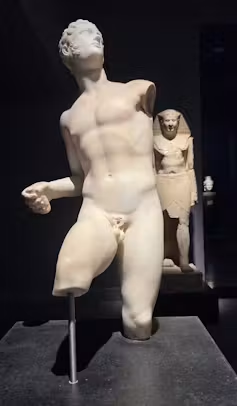
A more measured approach can be seen in the work of the Greek archaeologist Calliope Papakosta in Alexandria, Egypt. During a visit to her excavations, she showed me evidence suggesting that Alexander the Great’s tomb might lie nearby. The most convincing object was a marble statue of a young warrior that she argued, and I agree, can represent Alexander.
Kirk Fischer
The style was consistent with the school of Lysippus, Alexander’s court sculptor. Unfortunately, the sculpture was discarded in a Roman fill layer and thus removed from its original context.
Papakosta recognized both the promise and the limitations of the evidence. While hopeful that her work would illuminate the fate of Alexander’s tomb, she consistently framed her discoveries within the limits of what the data proved.
Jay Silverstein, Author provided (no reuse)
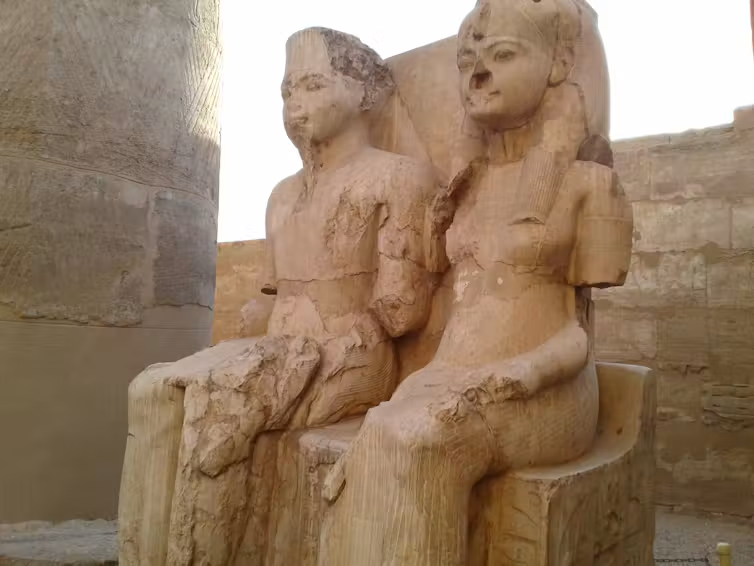
The debate surrounding Tutankhamun’s tomb raises similar issues. The cemetery is unusually small for one hosting a pharaoh, and Nicholas Reeves has argued that it is only the outer part of a larger Amarna period (c. 1350-1325 BC).
The tomb’s abnormality is widely accepted and it was believed to be a small private tomb that was hastily adapted for the king due to his death at a young age.
A suggestion of door seams in the decorated north wall of the cemetery stimulates the extended tomb complex theory, but damaging the wall to try it would be out of the question. Progress would therefore depend on geophysics providing a means of looking through the wall without damaging it.
The first investigations used relatively low frequency Ground Penetrating Radar (GPR), mainly in the 400-900 megahertz (MHz) range. Such frequencies provide greater penetration into the surrounding limestone than higher frequency radar. But this comes at the expense of spatial resolution. Later investigations expanded this range and included frequencies as high as 3 gigahertz (GHz).
Stacey Silverstein, Author provided (no reuse)
My own inclination would have been to place particular emphasis on the highest frequency radar antennas (the parts of the GPR system that transmit and receive electromagnetic pulses) because resolving whether the North Wall contains evidence of a door seam is an important first step in answering other key questions.
High frequency systems offer less penetration but are generally better suited to detect subtle structural discontinuities directly behind the wall surface.
More recent investigations added microgravity surveys made from above the theorized complex. These measure minute variations in the Earth’s gravitational field, caused by differences in density beneath the ground. Higher frequency GPR has also now been added to the team’s toolkit.
The history collection
This was a meaningful evolution of the research strategy. The problem was, in order to protect the wall paintings, the GPR antennas could not be placed directly against the decorated surfaces.
The resulting air gap weakens the coupling between the antenna and the wall, reducing signal quality and complicating interpretation. For GPR, the further the antenna is from the surface, the more difficult it becomes to resolve subtle architectural features.
Microgravity surveys do not suffer from this limitation. They are able to identify anomalies in the limestone under the sensor. The challenge for both types of investigations is that they did not produce unequivocal evidence for a large open chamber directly above the wall.
To account for this, proponents of the hidden chamber hypothesis have suggested that all passages are deliberately filled with debris, hiding the invalid signatures that investigators originally expected to discover. This is plausible and deserves further testing, but it remains an interpretation, not a fact.
Some investigators have argued that the currently available geophysical evidence does not indicate the presence of hidden chambers.
This led to the next logical step in the scientific process: direct testing. The current proposal to drill a small borehole and install miniature cameras in one of the identified anomalies has the potential to move the discussion from inference to observation.
Whatever the outcome, the investigations conducted by Eldamaty and colleagues represent the most comprehensive scientific assessment of the question to date.
Currently, the hidden chamber theory remains exactly what a good scientific hypothesis should be: intriguing, testable, and worthy of investigation. What it is not yet, at least, is a discovery.
