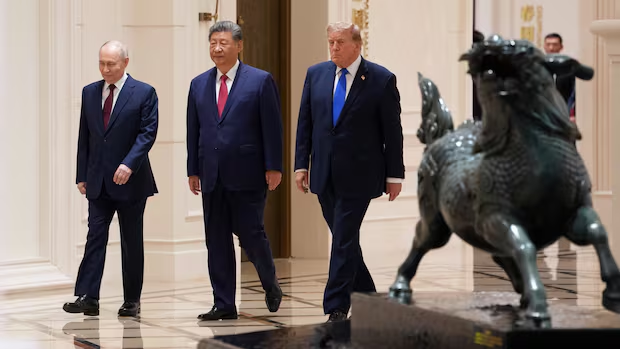
US President Donald Trump and Chinese and Russian counterparts Xi Jinping and Vladimir Putin met on Thursday for an unprecedented trilateral meeting, ending their talks after more than an hour.
Sitting around a large round table in a villa in the southern Chinese city of Shenzhen, on the sidelines of an Asia-Pacific summit, the heads of the world’s major nuclear powers took turns to give opening remarks.
“We’re really making history,” Trump said. “You three of us have a lot to discuss.”
“No peace was ever forged by diminishing opportunities for engagement.”
The three leaders were expected to discuss the war in Ukraine and nuclear arms control.
Putin said the three countries “have many shared interests in the resolution of regional conflicts, including, obviously, the conflict in Ukraine.”
Unlike Trump and Putin, Xi – who Chinese state media said was presiding over the meeting – made no reference to Ukraine, but said: “History tells us that when great powers live in harmony, the world is at peace. When great powers oppose each other, the world falls into turmoil.”
The trilateral is unlikely to produce major agreements, analysts say, because of deep differences over Ukraine, Iran, nuclear weapons and trade. But it has upset smaller countries, which fear their interests may be ignored.
Before the meeting, Trump met separately with Xi and Putin, referring to both as friends.
Trump said both he and Xi felt strongly about oil flowing through the Strait of Hormuz, which has been disrupted by the Iran war. Xi has not mentioned Ukraine or Iran in any of his remarks during the two-day summit so far.
Patricia Kim, foreign policy fellow at the Brookings Institution, said China does not want to be seen as brokering an agreement on Ukraine, because the “problematic optics” of Kiev and European leaders do not participate.
“Xi has characterized the war between Russia and Ukraine as fundamentally a European problem, which makes Beijing even less inclined to take responsibility for the solution,” Kim said.
Fanfare and performances
Speaking to Fox News earlier, Trump highlighted the fanfare surrounding his arrival for the summit, which contrasted with the more muted welcome from other leaders, including Putin. Japanese Prime Minister Sanae Takaichi landed without a welcoming ceremony.
Japan’s relations with China have deteriorated since Takaichi’s comments in 2025, when she said Japan could deploy its military if a Chinese move into Taiwan threatened its territory as well.
Takaichi, who cut an isolated figure throughout the summit, said Tokyo’s position on Taiwan has not changed since 1972.
Japan and Taiwan reported Russian military aircraft incursions this week as Moscow signaled it could still project power in Asia despite its preoccupation with Ukraine. On Taiwan, Xi told Trump that the United States would “do the right things” to avoid major setbacks in their relationship.
Xi greeted Trump at the airport, the first time he has done so with a visiting leader since becoming president, contradicting his counterpart’s gesture at Joint Base Andrews in September when they last met. The leaders also briefly hugged each other.
“This is a great president, one of the great presidents of China, and he never went to the airport to meet somebody,” Trump said.
“And not only that, the fanfare, the beauty, the game, the thousands of people, the young children, the soldiers, the whole thing. It was a great respect, and I appreciate that. That’s a big win for us. It’s also a big win for China.”
Trump arrived after Xi and Putin delivered pointed speeches condemning Western trade “protectionism” and sanctions.
During Thursday’s APEC proceedings, Xi called for “free and open” trade. Western leaders say China’s growth model that favors industrial strength over consumers is unfair and is creating destabilizing global trade imbalances.
Putin, fresh from a setback in his war against Ukraine after the collapse of a key bridge linking Crimea to Russia, said Russia was key to food and energy security in the Asia-Pacific.
Trump, reeling from a mid-term election loss and the Nvidia spying scandal, told the audience that the United States has been a Pacific power for hundreds of years.
Heavy nuclear weapons discussion
Trump has insisted that nuclear arms control is a central issue of the summit, despite China’s repeated objections to joining talks with Washington and Moscow, which have much larger nuclear arsenals.
“It’s not an easy thing to do — to give them up,” Trump told Xi and Putin at the start of their meeting.
The leaders have many reasons to appear together but much less to agree on substance because of differences over Ukraine, Iran, nuclear weapons, trade and China’s military buildup, said Craig Singleton of the Foundation for Defense of Democracies.
“A photo could serve all three men well,” Singleton said, adding that he thought the “agenda is much harder to agree on.”
Trump’s talks with Xi come after an extension of their trade truce this month, but also amid growing tensions over reports of Nvidia chips being diverted to China through Southeast Asia, questions about the effectiveness of US export routes and the future of Chinese access to advanced technology.
“This is Beijing’s worst nightmare. China wants chip access that it can negotiate with the president. It can get chip restrictions written into law by both parties,” Singleton said.